When you grab a bottle of pain reliever, cold medicine, or antacid off the shelf, you’re not just buying a brand-you’re buying a specific chemical. That chemical is the active ingredient, and it’s the only thing in the bottle that actually does the work. The rest? Fillers, colors, flavors, and preservatives. But most shoppers don’t realize that. They see "Tylenol," "Advil," or "Alka-Seltzer" and think they’re different medicines. They’re not. Not when it comes to what’s actually healing you.
What Exactly Is an Active Ingredient?
An active ingredient is the chemical compound in a medicine that produces the intended effect. It’s not a secret formula. It’s not proprietary. It’s listed right there on the label in plain language. For example, if you take a tablet labeled "acetaminophen 500 mg," that’s the exact amount of the pain-relieving substance inside. No tricks. No surprises. Just science.
The U.S. Food and Drug Administration (FDA) made sure of that back in 1999. They created the Drug Facts label-a standardized format that all over-the-counter (OTC) medicines must follow. Before that, labels were a mess. One bottle said "contains pain reliever," another said "analgesic," and most people had no idea what they were taking. A 1995 FDA study found 78% of shoppers couldn’t identify active ingredients on labels. So they fixed it. Now, every OTC product has seven clear sections: Active Ingredient(s), Purpose, Uses, Warnings, Directions, Other Information, and Inactive Ingredients.
And here’s the rule: Active ingredients are listed first, with exact amounts per dose. Not percentages. Not vague terms. You’ll see "ibuprofen 200 mg" or "diphenhydramine HCl 25 mg." That’s the dose. That’s what your body absorbs. That’s what affects your liver, your blood pressure, your sleep.
Why This Matters More Than You Think
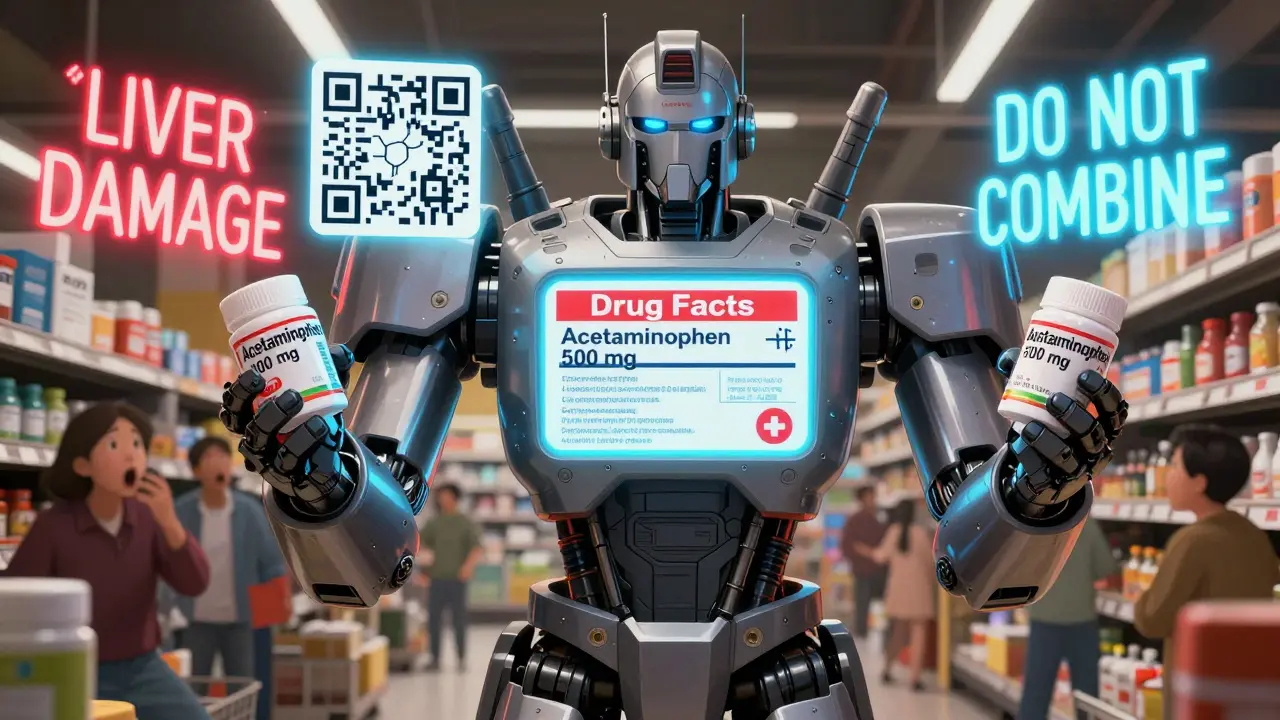
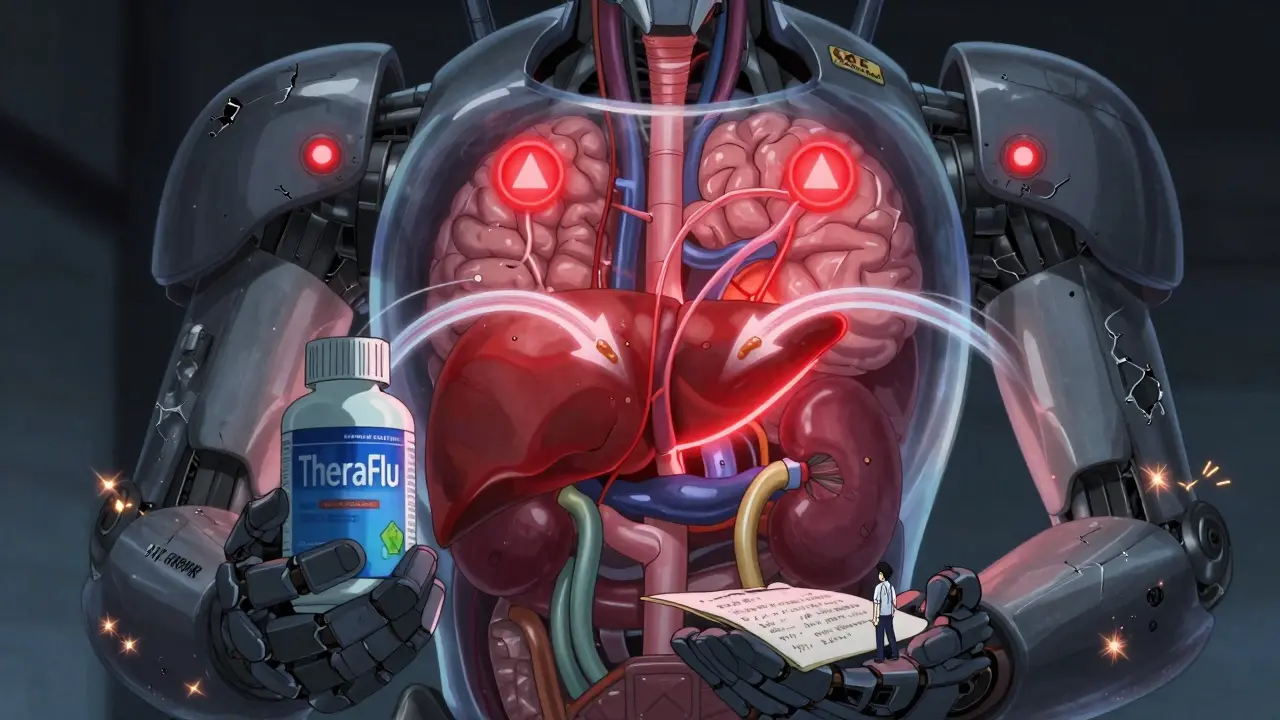
Let’s say you take Tylenol for a headache. Later, you feel stuffy, so you grab "TheraFlu Nighttime." You think it’s just a cold remedy. But TheraFlu also contains acetaminophen-650 mg per dose. You just took 500 mg. Now you’ve consumed 1,150 mg in one day. The safe limit? 4,000 mg for adults. Sounds fine, right? But if you do this every night for a week? Your liver doesn’t know the difference between "Tylenol" and "TheraFlu." It just sees acetaminophen. And too much of it can cause liver damage-even failure.
This isn’t rare. In 2022, the FDA reported that 70% of OTC medication errors happened because people didn’t check active ingredients. One Reddit user shared: "I took two Tylenol and then a TheraFlu. I ended up in the ER with liver toxicity." That’s not a horror story. It’s a common mistake.
And it’s not just acetaminophen. Cold medicines often combine dextromethorphan (cough suppressant), phenylephrine (nasal decongestant), and antihistamines. If you’re on blood pressure meds, phenylephrine can spike your pressure. If you’re pregnant, diphenhydramine (Benadryl) might not be safe. If you’re elderly, even 25 mg of diphenhydramine can cause confusion or falls.
The Top 5 Active Ingredients You Need to Know
You don’t need to memorize all 800+ active ingredients out there. But these five cover 70% of OTC use:
- Acetaminophen (Tylenol, TheraFlu, NyQuil): Pain and fever relief. Max daily dose: 4,000 mg. Danger zone: Liver damage if you take too much or combine with alcohol.
- Ibuprofen (Advil, Motrin, Aleve): Anti-inflammatory. Reduces swelling. Max daily dose: 1,200 mg OTC. Danger zone: Stomach bleeding, kidney stress, worsens high blood pressure.
- Diphenhydramine (Benadryl, NyQuil, ZzzQuil): Antihistamine. Helps with allergies and sleep. Max dose: 50 mg per dose. Danger zone: Drowsiness, dry mouth, confusion in older adults.
- Dextromethorphan (Robitussin, Delsym): Cough suppressant. Max dose: 120 mg/day OTC. Danger zone: Can be misused recreationally; high doses cause hallucinations.
- Loperamide (Imodium): Diarrhea treatment. Max dose: 8 mg/day OTC. Danger zone: People have abused it as an opioid substitute-over 160 deaths reported from 2012-2022.
Notice something? Each one has a hidden risk. That’s why the FDA limits doses. OTC versions have lower concentrations than prescriptions. For example, prescription ibuprofen is 400-800 mg per tablet. OTC? Only 200 mg. That’s intentional. Safety first.
How to Read the Drug Facts Label (Step by Step)
You don’t need a pharmacy degree. Just four steps:
- Find "Active Ingredient"-It’s the first section on the label. Always.
- Check the name and amount-Is it acetaminophen? 500 mg? 325 mg? Write it down if you’re taking multiple meds.
- Compare with what you’re already taking-If you’re on a cold medicine with acetaminophen, don’t also take Tylenol. You’ll double up.
- Look at the "Warnings" section-If it says "Do not use if you have liver disease," that’s not a suggestion. That’s a warning.
Experts at Nationwide Children’s Hospital recommend spending at least 45 seconds reading the label. Their study found this simple habit reduces medication errors by 68% in parents. That’s not hype. That’s data.
Brand Names Don’t Matter-Ingredients Do
Here’s the truth: Tylenol, Equate, Up & Up, and CVS Health all sell acetaminophen. The same exact chemical. Same dose. Same effect. The only difference? Price. Brand-name products cost more because of marketing. Generic brands cost less because they skip the ads.
Consumer Reports surveyed 2,148 adults in 2023. Only 28% correctly knew that "Aleve" contains naproxen sodium. But 72% knew "Tylenol" has acetaminophen. Why? Because Tylenol’s been on TV for decades. Naproxen? Not so much.
That’s why the Consumer Healthcare Products Association launched "Know Your Active Ingredients" in January 2023. They’re putting QR codes on packaging that link to clear explanations. In stores where they’ve rolled it out, acetaminophen-related ER visits dropped 19% in six months.
What’s Changing in 2026?
By 2026, every OTC medicine sold in the U.S. will be required to have a scannable QR code that links to a digital Drug Facts label. Why? Because many people-especially older adults or those with low health literacy-struggle to read small print. The QR code will show full ingredient lists, warnings, and even interactions with common prescriptions.
And it’s not just about convenience. The FDA estimates this will cut medication errors by 32%. That’s thousands of avoided hospital visits each year.
Also, the FDA has tightened rules on acetaminophen. While OTC tablets still max out at 500 mg per tablet, manufacturers now must include a "Liver Warning" box on every package. It’s bold. It’s red. It’s hard to miss.
What You Can Do Today
Next time you buy OTC medicine:
- Don’t pick it up and walk away.
- Stop. Read the label.
- Write down the active ingredient and dose.
- Check your other meds. Are you doubling up?
- If you’re unsure, ask the pharmacist. They’re trained for this.
It takes 30 seconds. But it could save your liver. Or your kidneys. Or your life.
And remember: If two products have the same active ingredient, they’re functionally identical. One isn’t "stronger" just because it costs more. One isn’t "better" because it has a fancy logo. It’s chemistry. Not marketing.