Imagine standing up to walk to the kitchen, only to find your legs feeling like lead weights. Within hours, that weakness spreads upward, making it hard to breathe or swallow. This isn’t a stroke or a heart attack-it’s Guillain-Barré Syndrome, a rare but serious autoimmune disorder where your immune system mistakenly attacks your own nerves. Known as GBS for short, this condition is a medical emergency. It doesn’t discriminate by age or gender, striking about 1 to 2 people out of every 100,000 in the United States each year. The good news? If caught early, effective treatments exist to stop the damage and help you recover.
What Is Happening Inside Your Body?
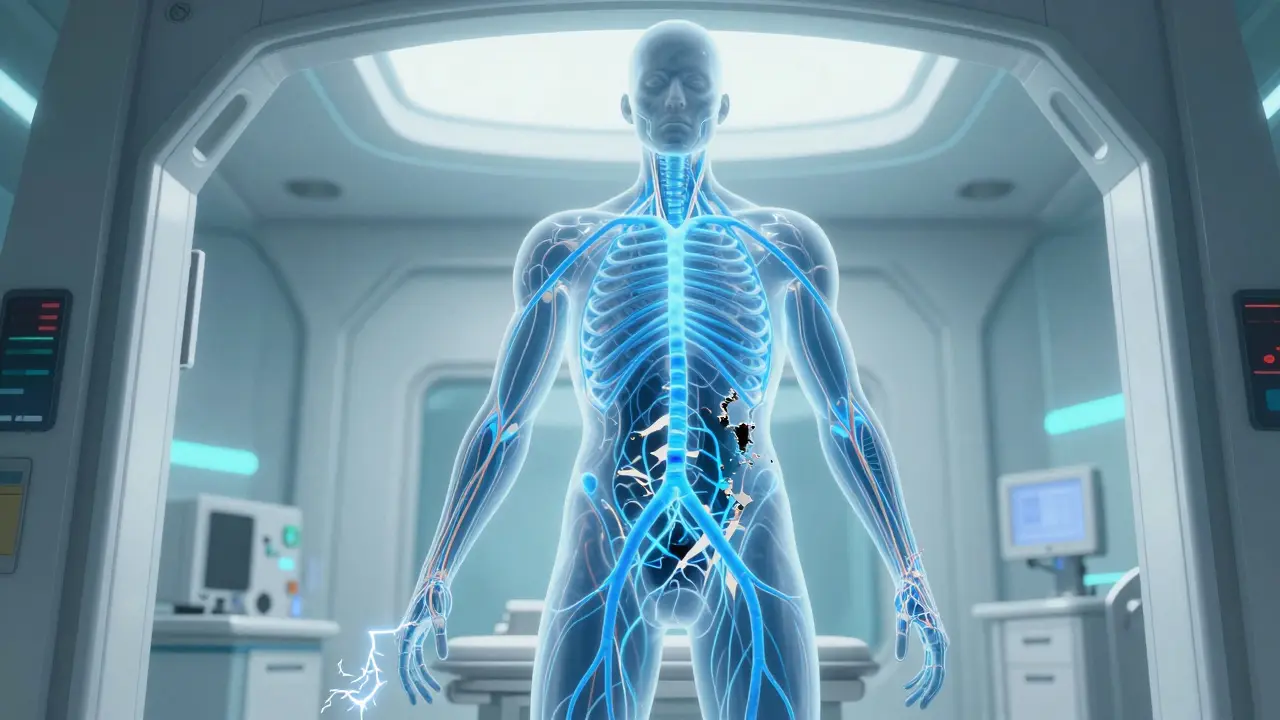
To understand why you can’t move, you have to look at the wiring. Your nervous system has two main parts: the central nervous system (brain and spinal cord) and the peripheral nervous system, which carries signals from your spine to your muscles. In most cases of GBS, specifically the subtype called Acute Inflammatory Demyelinating Polyradiculoneuropathy (AIDP), your immune system strips away the protective coating around these nerves, known as myelin. Think of myelin as the plastic insulation on an electrical wire. When that insulation is damaged, the signal slows down or stops completely. That’s why your muscles don’t get the message to contract.
This usually starts after an infection. About three weeks before symptoms begin, many patients report a stomach bug, flu, or respiratory illness. Campylobacter jejuni, a bacteria often found in undercooked poultry, is responsible for 20-40% of GBS cases. Other culprits include Cytomegalovirus (CMV) and Epstein-Barr virus (EBV). Sometimes, the body fights off these germs so aggressively that it gets confused and starts attacking nerve tissues that look similar to the invaders-a process scientists call molecular mimicry.
Recognizing the Warning Signs
GBS moves fast. You won’t have days to wait and see if it gets better. The hallmark sign is symmetrical, ascending weakness. It typically begins in your feet and ankles, then climbs up to your thighs, hips, arms, and face. Because it affects both sides of the body equally, you might notice difficulty walking, climbing stairs, or buttoning shirts. About half of patients also experience cranial nerve issues, leading to facial drooping or trouble swallowing.
Here are the specific red flags that mean you need immediate medical attention:
- Rapidly worsening muscle weakness: Going from mild fatigue to inability to stand within hours or days.
- Loss of reflexes: A doctor tapping your knee with a hammer elicits no kick (areflexia).
- Breathing difficulties: Feeling short of breath even when resting.
- Heart rhythm changes: Palpitations or dizziness due to autonomic instability.
- Pain: Many patients describe deep back pain or leg cramps before the weakness becomes severe.
If you suspect GBS, do not drive yourself to the hospital. Call emergency services. Up to 30% of patients require mechanical ventilation because their breathing muscles become too weak to function.
Diagnosis: Confirming the Cause Quickly
Time is critical. Neurologists use a combination of tests to confirm GBS and rule out other conditions like botulism or myasthenia gravis. Misdiagnosis happens in 5-10% of cases, so thorough testing is essential.
The first test is often a lumbar puncture, commonly known as a spinal tap. Doctors remove a small amount of cerebrospinal fluid to check for protein levels. In GBS, you’ll see high protein but normal white blood cell counts, a pattern called albuminocytological dissociation. However, this result might not show up until the second week of illness, so doctors rely on other tools initially.
Nerve conduction studies are another key diagnostic tool. These tests measure how fast electrical signals travel through your nerves. In AIDP, the signals are significantly slowed down due to demyelination. Electromyography (EMG) may also be used to assess muscle health. Together, these tests help neurologists determine the severity and type of GBS, guiding the choice of treatment.
IVIG: The First-Line Defense
Once diagnosed, the goal is to stop the immune system’s attack immediately. The two primary treatments are intravenous immunoglobulin (IVIG) and plasma exchange (also called plasmapheresis). Research shows they are equally effective, but IVIG is generally preferred because it is less invasive and easier to administer.
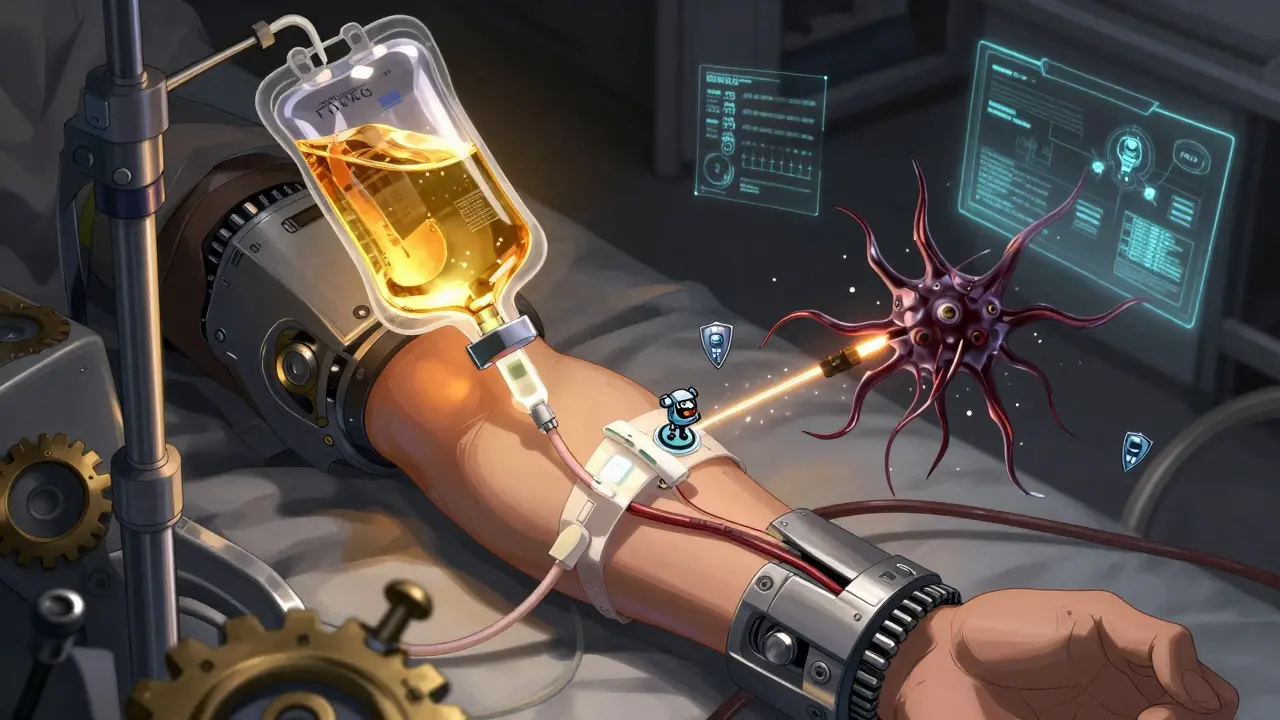
IVIG involves infusing healthy antibodies into your bloodstream via an IV line. These donated antibodies help neutralize the harmful autoantibodies attacking your nerves. The standard protocol is 0.4 grams per kilogram of body weight per day for five consecutive days. For an average adult, this means receiving several liters of solution over five days. Ideally, treatment should start within two weeks of symptom onset, though earlier is always better. Studies suggest that for every day treatment is delayed, efficacy drops by approximately 5%.
While IVIG saves lives and speeds recovery, it’s not without side effects. Headaches are the most common complaint, affecting about 25% of patients. Some describe them as severe migraines that feel like "a vice around the skull." Fever, chills, and nausea occur in roughly 15% of cases. More rarely, IVIG can cause kidney stress or blood clots, particularly in older adults or those with existing cardiovascular issues. Doctors monitor your hydration levels closely to prevent kidney strain.
Plasma Exchange: The Alternative Option
If IVIG isn’t available or suitable-for example, if you have a severe IgA deficiency-plasma exchange is the alternative. This procedure removes your blood, filters out the harmful antibodies in a machine, and returns the cleaned blood to your body. It requires a central line catheter, usually placed in the neck or chest, which makes it more invasive than IVIG.
A typical course involves 4 to 5 exchanges over one to two weeks. While equally effective at improving functional outcomes, plasma exchange has a higher complication rate (around 30%) compared to IVIG (15%), largely due to the risks associated with central lines and blood pressure fluctuations. It is often reserved for patients who cannot tolerate IVIG or those with severe respiratory failure who need rapid intervention.
| Feature | IVIG | Plasma Exchange |
|---|---|---|
| Invasiveness | Low (Standard IV) | High (Central Line Required) |
| Treatment Duration | 5 Days | 1-2 Weeks (4-5 sessions) |
| Common Side Effects | Headache, Flu-like symptoms | Hypotension, Infection risk |
| Cost (US Average) | $15,000 - $25,000 | $20,000 - $30,000 |
| Efficacy | Equivalent to Plasma Exchange | Equivalent to IVIG |

Recovery and Rehabilitation
The acute phase of GBS lasts about four weeks, during which symptoms stabilize. After that, the real work begins: rehabilitation. Recovery is slow and varies greatly from person to person. About 60% of patients achieve full functional recovery within six to twelve months. Another 30% have residual weakness that may require assistive devices like braces or walkers. Sadly, about 10% remain severely disabled.
Physical therapy is crucial. It helps maintain muscle strength, prevents joint stiffness, and retrain movement patterns. Occupational therapists teach you new ways to perform daily tasks while you regain independence. Pain management is also a major part of rehab, as many survivors deal with chronic neuropathic pain or fatigue long after the paralysis resolves.
Psychological support shouldn’t be overlooked. The sudden loss of mobility and the fear of recurrence can lead to anxiety and depression. Support groups, both online and in-person, provide valuable community and practical advice from others who have walked this path.
Future Treatments and Research
Science hasn’t stopped at IVIG and plasma exchange. Researchers are exploring complement inhibitors like eculizumab, which blocks the immune system’s complement pathway. Early trials showed promising results, with patients recovering 30% faster. Additionally, biomarker research aims to identify specific antibodies, such as anti-ganglioside antibodies, to predict which patients will respond best to certain treatments. Personalized medicine could soon allow doctors to tailor therapies based on your unique antibody profile, potentially reducing side effects and improving outcomes.
Is Guillain-Barré Syndrome contagious?
No, GBS itself is not contagious. You cannot catch it from someone else. However, the infections that trigger it, such as the flu or Campylobacter bacteria, can be spread. Practicing good hygiene helps prevent these triggering illnesses.
How long does IVIG treatment take to work?
Most patients notice stabilization of symptoms within a few days of starting IVIG. Significant improvement in strength often takes 2 to 4 weeks. Full recovery can take months to a year, depending on the severity of nerve damage.
Can vaccines cause Guillain-Barré Syndrome?
The risk is extremely low. Certain flu vaccines have been linked to a slight increase in GBS risk, but the risk from getting the flu itself is much higher. The benefits of vaccination far outweigh the minimal risk of developing GBS.
What is the difference between GBS and CIDP?
GBS is acute, meaning it develops rapidly and peaks within four weeks. Chronic Inflammatory Demyelinating Polyneuropathy (CIDP) is a chronic version that progresses over at least eight weeks. Both involve nerve damage, but CIDP requires long-term maintenance therapy, whereas GBS is treated acutely.
Are steroids effective for treating GBS?
No. Multiple clinical trials have shown that corticosteroids, alone or combined with IVIG or plasma exchange, do not improve outcomes in GBS. They are not recommended as a treatment for this condition.