
What Are Biosimilars, and Why Do They Matter?
Biosimilars aren’t generics. That’s the first thing to understand. While a generic pill is a chemical copy of a brand-name drug, a biosimilar is a highly similar version of a complex biologic medicine-made from living cells, not synthesized in a lab. These include drugs like Humira, Keytruda, and Eylea, used to treat cancer, autoimmune diseases, and vision loss. Because they’re made by living systems, even tiny changes in manufacturing can affect how they work. That’s why regulators like the FDA require years of testing to prove a biosimilar is as safe and effective as the original.
These drugs aren’t cheap to make. Developing one can cost $150 million to $250 million and take 7 to 10 years. But once approved, they’re priced 15% to 35% lower than the original. That’s why the healthcare system is watching closely. Between 2025 and 2030, over $200 billion in annual sales from top biologics will lose patent protection. That’s a massive shift waiting to happen.
The Patent Cliff: What’s Coming Between 2025 and 2030
The next few years are a turning point. The biggest blockbuster on the horizon is Keytruda (pembrolizumab), Merck’s cancer immunotherapy. In 2024, it brought in $25.5 billion in sales. Its core patent expires in 2028, but Merck has layered on over 200 other patents, some extending protection until 2035. Still, at least 14 companies are already in late-stage trials for Keytruda biosimilars, including Coherus BioSciences and a partner of Merck itself.
Right behind it is Eylea (aflibercept), Regeneron’s treatment for macular degeneration. With $5.9 billion in U.S. sales in 2023, its patents expired in 2025. Three biosimilars-Yesafili, Opuviz, and Enzeevu-were approved by the FDA in 2024. By Q1 2025, they already made up 12% of the market. That’s faster than most expected.
Other major targets include Humira (adalimumab), which saw 12 biosimilars hit the U.S. market after its 2023 patent expiry. Within 18 months, 80% of new prescriptions went to biosimilars. Enbrel (etanercept) and Remicade (infliximab) followed similar paths. Now, attention turns to Cosentyx (secukinumab), with a biosimilar from Samsung Bioepis expected in the EU in 2026 and the U.S. in 2029.
But it’s not just about timing. Companies like Bristol Myers Squibb used pediatric exclusivity to delay competition on Eliquis until 2029. Merck’s patent strategy for Keytruda is a textbook example of how originators try to stretch protection. These legal maneuvers are why some experts call it a “patent thicket”-a maze of overlapping patents designed to block biosimilar entry.
Why Biosimilars Are Harder Than Generics
It’s not just about copying a molecule. Biologics are made from living cells-often modified with sugars, proteins, and other structures called post-translational modifications. For example, Keytruda’s cancer-fighting power depends on exact glycosylation patterns. If a biosimilar manufacturer gets that wrong, even slightly, the drug might not work the same way.
That’s why regulators demand way more data than for generics. Developers must show analytical similarity, run nonclinical studies, and often conduct clinical trials to prove no meaningful difference in safety or effectiveness. The FDA’s 351(k) pathway for biosimilars takes 12 to 18 months just to review a submission. And manufacturing? It requires specialized facilities. Samsung Bioepis spent $450 million on a plant in South Korea just to make biosimilars.
Even more complicated are drugs used in combination therapies, like cancer treatments. An Opdivo biosimilar must work safely with multiple chemotherapy drugs, each with its own dosing schedule. One small difference in how the immune system reacts could mean a patient has a bad outcome. That’s why some doctors are cautious, especially in oncology.

Market Entry: Who’s Winning and How
The biosimilar space is getting crowded-and consolidated. Sandoz (a Novartis spinoff) bought Biocon’s biosimilars business in August 2024 for $3.9 billion, becoming the market leader with 28% share. Pfizer teamed up with Mylan to form Viatris, a dedicated biosimilar commercialization arm. Alvotech, an Icelandic company, signed a $1.2 billion deal with Regeneron in January 2025 to co-develop biosimilars for Eylea.
Pricing is a big part of the game. Sandoz launched its Enbrel biosimilar at a 35% discount. Pfizer’s Ibrance biosimilar is expected to come in at 20-25% off. But it’s not always about the lowest price. Some companies are using value-based contracts. Sandoz and UnitedHealthcare agreed that if the biosimilar doesn’t save 25% compared to the original, UnitedHealthcare gets the difference back. That’s a new model.
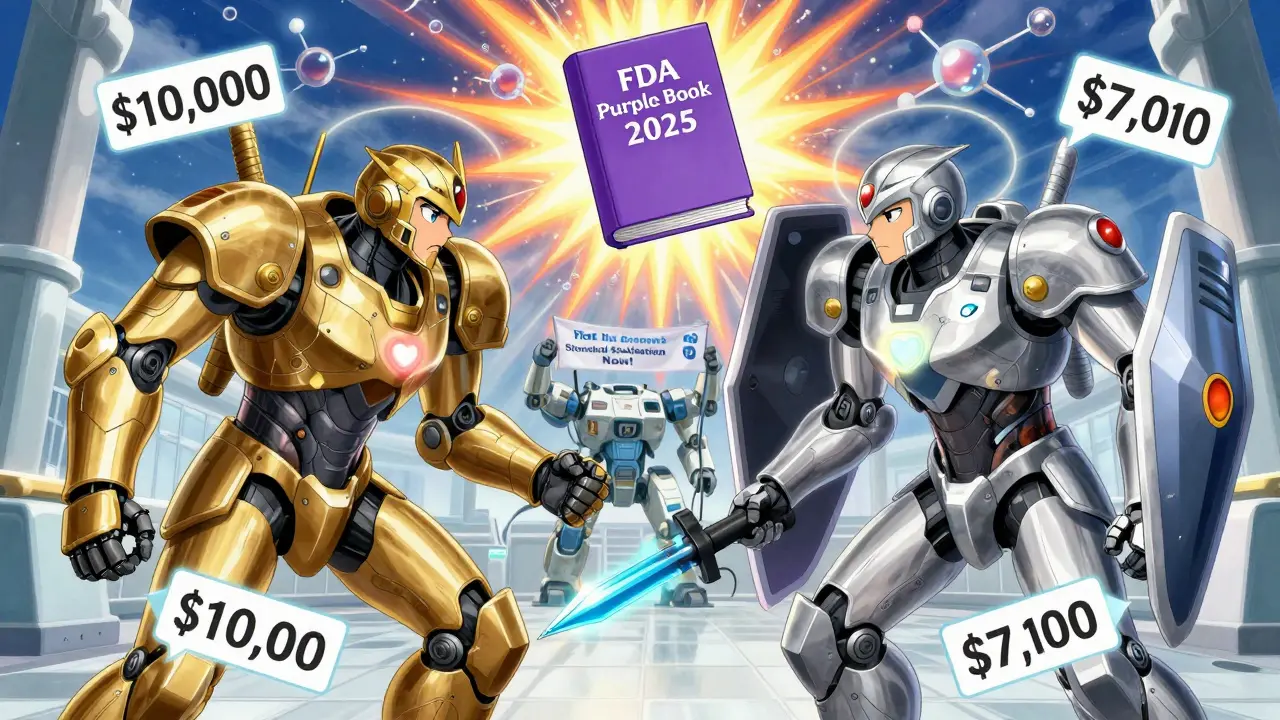
But there’s a catch. Medicare Part B reimburses providers based on the drug’s average sales price. That means if a doctor gives a patient a $10,000 reference drug, they get paid more than if they give a $7,000 biosimilar-even though the care is the same. This financial incentive slows adoption. Hospitals are fighting back. Kaiser Permanente now requires biosimilar substitution for all new filgrastim prescriptions. Mass General Brigham saw biosimilar use jump from 12% to 68% after changing its formulary rules.
Real-World Impact: Doctors, Patients, and Payers
Doctors are seeing results. Dr. Laura Chow at the University of Washington reported strong equivalence between Humira and its biosimilars in patients with inflammatory bowel disease. But Dr. Richard Pazdur from the FDA’s Oncology Center found some patients had unexpected immune reactions when switching between rituximab biosimilars and the original. That’s why substitution isn’t automatic. Only 12 products in the U.S. are labeled “interchangeable”-meaning a pharmacist can swap them without the prescriber’s approval. The rest require a doctor’s OK.
Patient feedback is mixed. A November 2024 survey by the Cancer Support Community found 78% of patients were happy with the cost savings. But 34% said they were confused about whether they were getting a biosimilar or the original. Specialty pharmacists at CVS Caremark noticed a 22% drop in prior authorization denials for biosimilars in Q2 2025, which helps. But academic hospitals still struggle to track long-term outcomes across multiple biosimilar versions.
Payers are pushing hard. Centene Corporation now requires biosimilars for all new patients on TNF inhibitors. Cigna’s 2025 Medicare Advantage plans charge $0 copay for biosimilars versus $50 for the original. That’s a huge nudge.
Where the U.S. Stands Compared to the Rest of the World
In Europe, biosimilar adoption is way ahead. The European Medicines Agency has approved 82 biosimilars. In some cases, over 70% of prescriptions are for biosimilars. Why? Simpler reimbursement rules. No patent thickets. More aggressive price negotiations.
In the U.S., only 47 biosimilars are approved. But the pace is accelerating. The FDA approved 17 biosimilars in 2024-up from just 5 in 2020. The agency’s 2025 draft guidance on “Analytical Similarity for Highly Complex Biologics” could speed up approvals for next-gen drugs like antibody-drug conjugates.
Still, the U.S. accounts for 45% of global biosimilar sales, even though it only makes up 30% of global biologics use. That means the potential here is huge-if the system can get out of its own way.
The Big Picture: Savings, Challenges, and What’s Next
The Congressional Budget Office estimates Medicare will save $51 billion from 2026 to 2035 thanks to upcoming biosimilars. The RAND Corporation projects U.S. healthcare savings of $250 billion over the next decade. That’s money that could go to more patients, better care, or lower premiums.
But challenges remain. Patent litigation still delays entry-remember how Humira biosimilars were held back for nine years? The FDA’s January 2025 rule on “Purple Book Modernization” requires real-time patent updates, which could help. Still, originator companies are adapting. They’re launching authorized generics, making minor tweaks to their drugs, or bundling them with services.
Some experts warn that next-generation biologics-drugs with new mechanisms of action-could limit biosimilar impact. BMO Capital Markets thinks biosimilars might only capture 55% of the revenue from expiring drugs, not 75% as Goldman Sachs predicts.
One thing’s clear: the wave is here. Biosimilars are no longer a future possibility. They’re a present reality-and they’re changing how we treat cancer, arthritis, and vision loss. The question isn’t whether they’ll arrive. It’s whether the system is ready to use them well.



Geri Rogers
February 2, 2026 AT 16:26Okay but let’s be real-why are we still acting like biosimilars are some kind of miracle cure? 🤦♀️ I’ve seen patients switch from Humira to a biosimilar and get zero difference in relief… but then some weird flare-up because the pharmacy swapped it without telling them. The system is broken if we’re saving money but risking people’s health. Pharma’s playing chess while patients are just pawns. #BiosimilarProblems
Janice Williams
February 3, 2026 AT 09:36It is, without question, an egregious misallocation of regulatory resources to permit the introduction of biosimilars under the premise of "high similarity," when the very nature of biologics precludes absolute equivalence. The FDA's 351(k) pathway represents a dangerous dilution of scientific rigor, and the consequent erosion of therapeutic certainty is an affront to evidence-based medicine. One cannot replicate a living system without introducing variability-and variability, in this context, is tantamount to negligence.
Ed Mackey
February 5, 2026 AT 07:27kinda wild how sandoz just bought biocon’s whole biz for 3.9b and now they’re the big dog in biosimilars. i didn’t even know biocon existed until last week. also, i think the part b reimbursement thing is totally messed up-why does the doc get paid more if they give the expensive drug? that’s like paying a mechanic more if they fix your car with gold parts instead of regular ones. 🤔
Katherine Urbahn
February 5, 2026 AT 20:31It is imperative to note, with the utmost urgency, that the FDA’s approval of biosimilars-despite the lack of long-term, longitudinal, peer-reviewed, multi-center, double-blind, placebo-controlled trials-is not merely premature; it is, in fact, a public health hazard. Moreover, the notion that "patients are happy with cost savings" is a fallacy, propagated by insurance conglomerates, and ignores the psychological trauma of uncertainty in treatment. Patients deserve certainty, not coupons.
Joseph Cooksey
February 7, 2026 AT 05:42You know, it’s fascinating how we’ve built an entire pharmaceutical ecosystem around the idea that a molecule’s origin story matters more than its function-like we’re still in the age of alchemy, where the philosopher’s stone is a patent number instead of gold. The fact that Merck has over 200 patents on Keytruda isn’t innovation-it’s legal gymnastics dressed up as R&D. And yet, we praise them as pioneers while the people who actually build the biosimilars-those engineers in Seoul, the scientists in Reykjavik-are treated like copycats. Maybe the real villain isn’t the biosimilar maker… it’s the system that rewards obstruction over access.
Coy Huffman
February 7, 2026 AT 15:18man i’ve been following this for years and honestly? i’m just glad we’re finally moving past the "biologics are too complex to copy" excuse. yeah, it’s harder than pills, but we’ve done harder things. i mean, we put a rover on mars. we can figure out how to make a safe biosimilar. also, i love how some docs are like "oh no my patient might react weirdly"-but they never say that about brand-name drugs changing batches. weird double standard. 🤷♂️
Amit Jain
February 8, 2026 AT 00:02in india we use biosimilars for years. cheap, good, no problem. humira copy cost 1/10 price. patient happy. doctor happy. government happy. usa make it so hard. why? too many lawyers. not enough patients.
Harriot Rockey
February 8, 2026 AT 10:03OMG I just read that Kaiser Permanente got biosimilar use from 12% to 68% by just changing formulary rules?? That’s wild!! 🙌 Like… why aren’t ALL hospitals doing this?? We’re talking about billions in savings and patients getting the same care. Let’s stop overcomplicating this. If it’s FDA-approved, let pharmacists swap it. No more drama. 💪💙 #BiosimilarsForAll