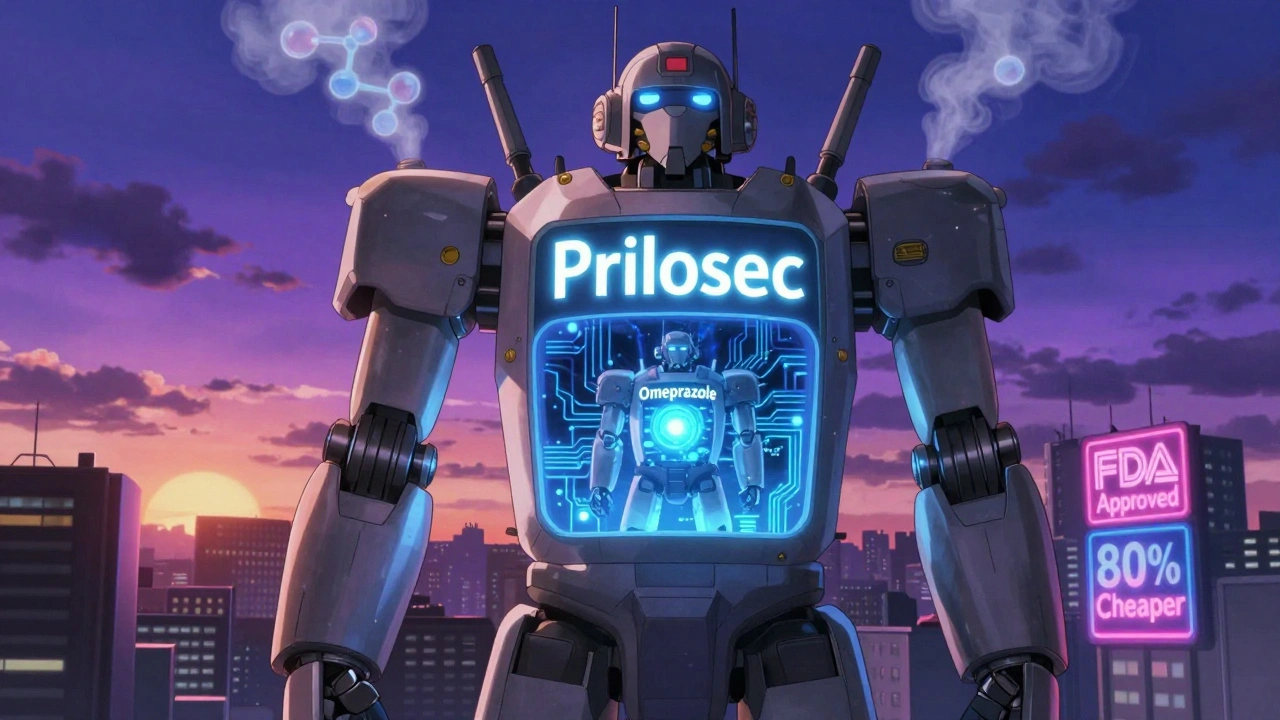
Have you ever looked at your prescription bottle and wondered why there are two names on it? One big, bold name you recognize, and another smaller one underneath that sounds like a chemical formula? You’re not alone. Many people feel confused when they see generic names on their medication labels instead of the brand names they’ve heard advertised on TV. But here’s the truth: those two names are pointing to the exact same medicine. The difference isn’t in what it does-it’s in what it costs, who made it, and how it looks.
What’s the Difference Between Generic and Brand Names?
The brand name is the trademarked name given by the company that first developed the drug. Think of Prilosec for heartburn or Lipitor for cholesterol. These names are carefully chosen to be memorable, often with catchy endings like “-pril” or “-tor.” The generic name is the actual chemical name of the active ingredient. For Prilosec, that’s omeprazole. For Lipitor, it’s atorvastatin. This is the name doctors use when writing prescriptions, and it’s the name the FDA uses to approve the drug’s safety and effectiveness. The FDA requires that generic versions contain the same active ingredient, in the same strength, and delivered the same way-as a tablet, capsule, or liquid-as the brand-name version. That means if your doctor prescribes omeprazole, a generic version of Prilosec, it will work the same way in your body. No guesswork. No compromise.Why Do Generic Drugs Cost So Much Less?
Brand-name drugs are expensive because the company that invented them spent years and billions of dollars on research, clinical trials, and marketing. According to Tufts Center for the Study of Drug Development, the average cost to bring a new drug to market is about $2.6 billion. That cost gets baked into the price. Generic manufacturers don’t have to repeat those expensive trials. Instead, they prove their version is bioequivalent-meaning it delivers the same amount of medicine into your bloodstream at the same rate as the brand-name drug. The FDA requires this to be within a tight range: 80% to 125% of the brand’s performance. That’s not a wide margin. It’s a strict standard. Because they skip the R&D costs, generics can be sold for 80% to 85% less. GoodRx reported in 2022 that a 30-day supply of brand-name Lipitor could cost around $300. The generic version? About $4. That’s not a discount. That’s a revolution in access.Are Generic Drugs Just as Safe and Effective?
Yes. And the evidence is overwhelming. The FDA doesn’t approve generics unless they meet the same quality, purity, and strength standards as the brand-name version. Every batch of generic medication is tested. Manufacturing facilities are inspected-just like brand-name plants. In fact, about half of all generic drugs are made by the same companies that produce the brand-name versions. They’re just sold under a different label. A 2022 analysis by University Hospitals found that 90% of all prescriptions filled in the U.S. are for generic drugs. That’s not because people are settling. It’s because they trust them. And with good reason. Some patients worry about side effects after switching. But clinical studies show no difference in how often side effects occur between generics and brand-name drugs. If you feel different after switching, it’s more likely due to changes in inactive ingredients-like fillers, dyes, or coatings-that affect how the pill dissolves in your stomach. These don’t change how the medicine works, but they can change how it feels.Why Do Generic Pills Look Different?
You’ve probably noticed this: your generic pill is a different color, shape, or size than the brand-name one you used to take. That’s not a mistake. It’s the law. In the U.S., trademark rules prevent generic manufacturers from making their pills look exactly like the brand-name version. That’s why you’ll see a blue oval where the brand had a white capsule. It’s to avoid confusion and protect the brand’s identity. But here’s the catch: those differences can cause confusion. Cedars-Sinai reported that 15% of medication errors involve patients mixing up pills because they look unfamiliar. That’s why it’s so important to read the label-not just the shape of the pill.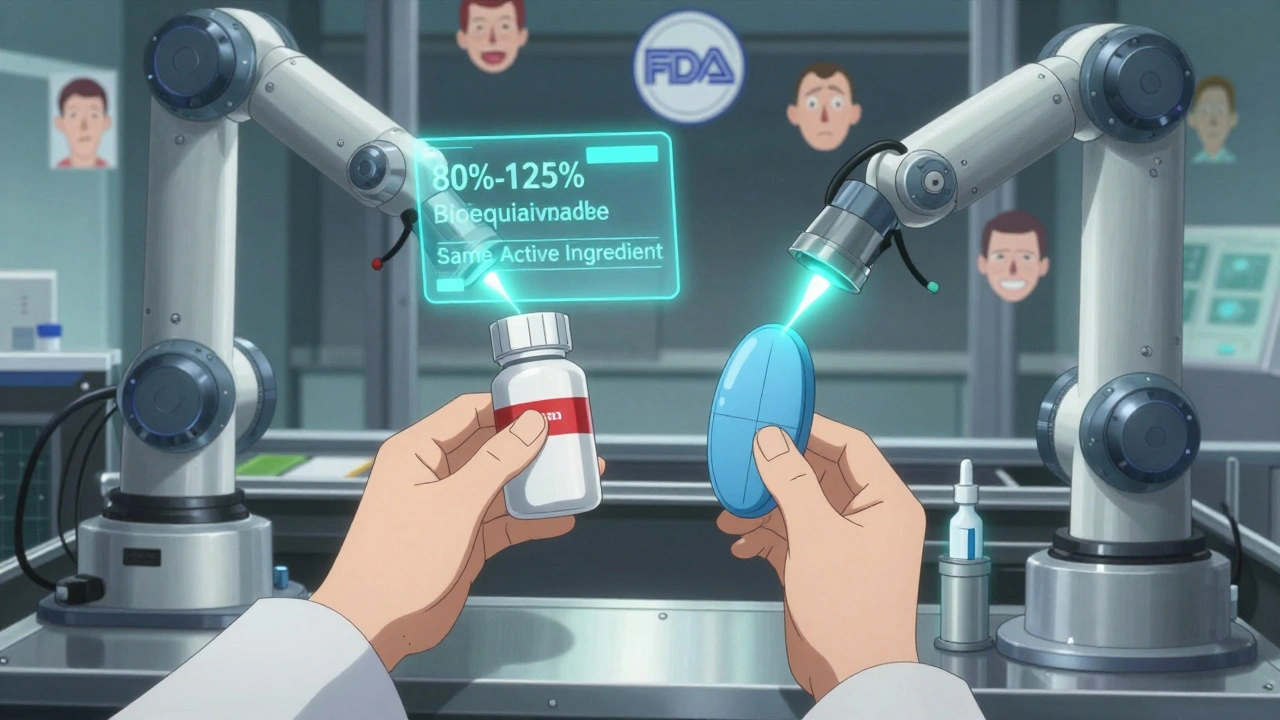
What You’ll See on Your Prescription Label
When you pick up your prescription, the label will show both names. The brand name (if one exists) is usually printed in larger font. Right below it, in smaller text, is the generic name. For example:- Brand Name: Nexium
- Generic Name: esomeprazole
When Might You Want to Stick With the Brand?
For most people, generics are the smart choice. But there’s a small group of drugs where even tiny differences matter. These are called narrow therapeutic index (NTI) drugs. They have a very small window between a dose that works and one that’s too much. Examples include warfarin (a blood thinner), levothyroxine (for thyroid conditions), and some seizure medications. While the FDA still considers generics of these drugs bioequivalent, some doctors prefer patients to stay on the same version-brand or generic-to avoid any potential fluctuations. If you’re on one of these medications, talk to your doctor before switching. Don’t assume the rules are the same for all drugs.What Patients Really Think
Surveys show that 78% of patients are satisfied with generics once they understand they’re the same. But 32% still worry they’re less effective-mostly because they’ve never been told otherwise. Online forums like Reddit’s r/pharmacy are full of stories. Some people report feeling different after switching-headaches, nausea, or a sense that the medicine “isn’t working.” But when researchers dig into the data, those reports don’t match actual blood levels or clinical outcomes. Often, it’s the placebo effect-or a change in inactive ingredients. One patient shared on GoodRx that switching from brand-name sertraline to the generic version dropped their monthly cost from $450 to $5. They said they felt the same-just less stressed about paying the bill.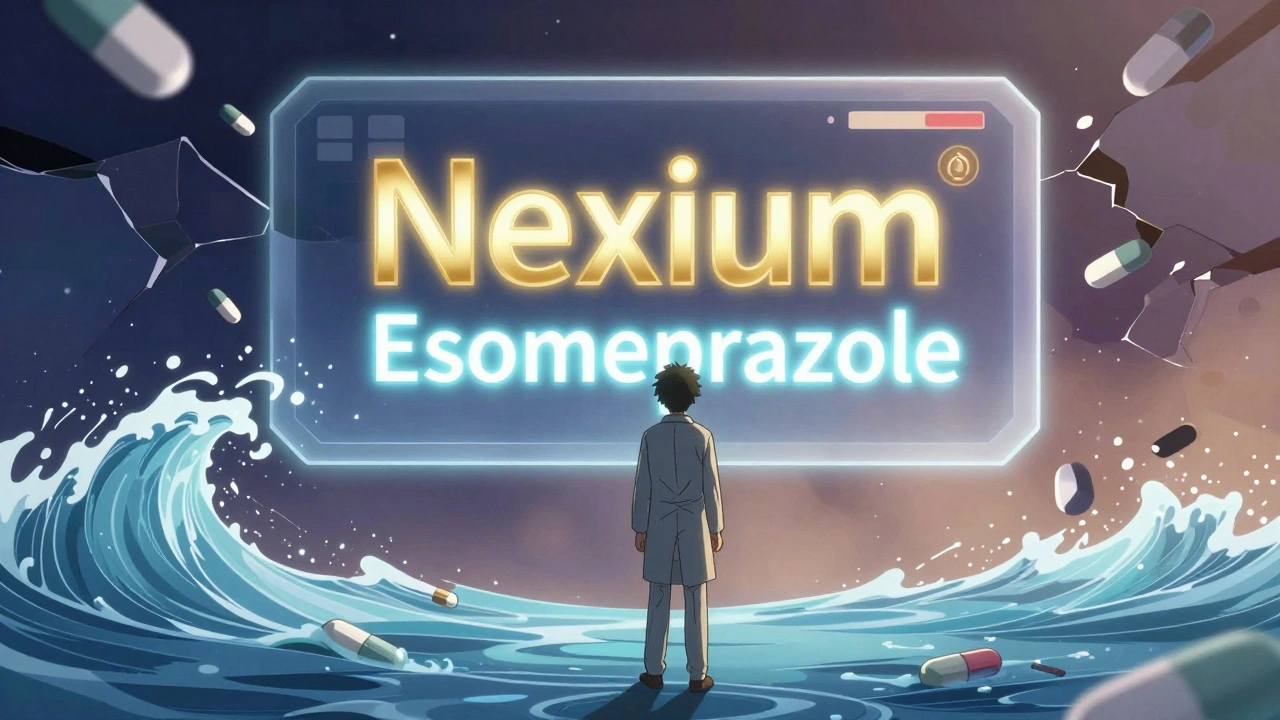
What’s Changing in 2025?
The landscape is shifting fast. By 2026, UCSF predicts 78% of all prescriptions will be generic-even more than today. Why? Because more biologic drugs (like those for arthritis or cancer) are losing patent protection, opening the door for biosimilars-similar to generics but for complex protein-based drugs. The Inflation Reduction Act of 2022 caps out-of-pocket drug costs for Medicare Part D at $2,000 a year starting in 2025. That will push even more seniors toward generics, since they’re the cheapest option. The FDA is also speeding up approvals under its GDUFA III program, aiming to cut approval times by 20% by 2027. That means more generics will hit the market faster. But there’s a warning: over 80% of the active ingredients in U.S. medications come from just two countries-China and India. Supply chain issues, like those during the pandemic, can cause shortages. That’s why some pharmacists now keep a backup brand-name version on hand, just in case.What You Should Do
You don’t need to be a pharmacist to understand your Rx label. Here’s what to do:- Look for the generic name. It’s the key. Write it down if you need to.
- Ask your pharmacist: “Is this generic? Is it the same as the brand?” They’re trained to explain this.
- If you feel different after switching, don’t assume it’s the medicine. Ask about inactive ingredients-dyes, fillers, coatings. These can cause minor reactions.
- Never stop or switch meds without talking to your doctor or pharmacist.
- Use tools like GoodRx to compare prices. Often, the generic is cheaper even without insurance.

aditya dixit
December 4, 2025 AT 19:21It’s wild how we’ve been conditioned to equate price with quality. I used to refuse generics until I saw my grandfather’s insulin bill drop from $400 to $12. Same active ingredient. Same results. He didn’t feel any different-except he stopped skipping doses because he could afford them. The real tragedy isn’t the pill color. It’s that people still believe the marketing.
Lynette Myles
December 5, 2025 AT 14:33They’re not the same. The fillers are laced with microchips. You think the FDA’s in charge? Think again.
Jimmy Jude
December 6, 2025 AT 00:13Oh wow. So let me get this straight-you’re telling me the pharmaceutical industry, which has spent decades convincing us that brand names = safety, is now asking us to trust a white capsule with no logo? That’s not science. That’s psychological warfare. And I’m not buying it. Not one bit.
Chris Brown
December 7, 2025 AT 08:12While I appreciate the attempt at public education, the tone of this piece borders on propaganda. The FDA’s bioequivalence standard of 80%-125% is not a guarantee of therapeutic equivalence-it is a statistical allowance. To equate this with ‘the same medicine’ is misleading. The patient experience is not reducible to plasma concentration curves.
Carole Nkosi
December 9, 2025 AT 02:29Let me tell you something-your precious generics are made in China by factories that dump waste into rivers and pay workers $2 a day. You think your ‘$4 pill’ is ethical? It’s blood money wrapped in a label. And don’t even get me started on how they control the supply chain. You’re not saving money-you’re enabling exploitation.
Mellissa Landrum
December 9, 2025 AT 04:08generic pills are fake and the gov is lying to us. i switched and got a headache for 3 days. they put poison in em to make us dependent. why do u think they make em look diff? so u dont know ur being drugged.
Mark Curry
December 9, 2025 AT 06:33My mom’s been on generic metformin for 8 years. No issues. She says the pill’s bigger but it works. I think people just need to give it a shot. :)
an mo
December 10, 2025 AT 05:11The bioequivalence window is a regulatory loophole disguised as consumer protection. The 80%-125% range allows for pharmacokinetic variance that can trigger subtherapeutic or toxic exposure in polypharmacy patients-especially those with CYP450 polymorphisms. This isn’t about cost-it’s about risk stratification failure in population-level prescribing.
Lucy Kavanagh
December 11, 2025 AT 07:47Oh honey, I read this whole thing and I just had to tell you-I used to be scared of generics too, until my pharmacist in London sat me down and showed me the batch numbers. Turns out, my brand-name blood pressure med? Made in the same factory as the generic. Same machines. Same inspectors. I cried. Not because I was sad-because I felt stupid for trusting ads over facts.
Stephanie Fiero
December 11, 2025 AT 17:25i switched to generic sertraline and felt like a zombie for 2 weeks. i went back to brand and boom-back to normal. so yeah, theyre NOT the same. and the pharmacists just dont get it. they think its all in your head. its not.
Michael Dioso
December 13, 2025 AT 16:22Oh please. You’re acting like generics are some miracle of modern science. The fact that half of them are made by the same companies that make the brand names proves nothing. It proves they’re just rebranding. And don’t even get me started on how they change the coating to make it ‘look different’-that’s a scam to make you think it’s inferior. Wake up.
Krishan Patel
December 13, 2025 AT 19:23Let me be clear: the idea that generics are ‘just as good’ is a dangerous illusion. The FDA’s standards are designed for mass production, not individual physiology. I’ve seen patients on levothyroxine fluctuate wildly between brands-because the fillers affect absorption. You don’t treat a thyroid like a headache. This isn’t economics-it’s biology. And we’re treating it like a commodity. That’s not progress. That’s negligence.