
When a hospital decides which drugs to stock, it’s not just about what’s on the shelf. It’s about cost, safety, and clinical outcomes-all weighed by a small group of experts who meet regularly to make decisions that affect every patient’s care. This process is called formulary economics, and at its core is the selection of generic medications. Hospitals don’t just pick the cheapest option. They pick the one that works, is reliable, and won’t break the budget.
What Is a Hospital Formulary?
A hospital formulary is a living list of approved medications. It’s not a static catalog. It’s updated every few months based on new evidence, supply issues, and cost changes. This list is managed by the Pharmacy and Therapeutics (P&T) committee-a team of pharmacists, physicians, and sometimes nurses who meet monthly or quarterly. Their job isn’t to buy drugs. It’s to decide which ones actually belong in the hospital.
Unlike retail pharmacies, where patients choose their own meds, hospitals control every step. A nurse administers the drug. A pharmacist verifies it. A doctor prescribes it. So the formulary has to account for how drugs are used in a controlled, high-stakes environment. A pill that works fine at home might cause problems in an ICU if it’s not absorbed the same way. That’s why a generic drug approved by the FDA doesn’t automatically make it onto a hospital formulary.
The Three Rules of Generic Selection
P&T committees use three non-negotiable criteria to evaluate any drug-brand or generic:
- Efficacy: Does it work as well as the brand? Not just in theory, but in real hospital patients-with kidney failure, sepsis, or liver disease.
- Safety: Are there hidden risks? Some generics, especially complex ones like inhalers or injectables, have different excipients or delivery systems. A 2023 survey found that 68% of hospital pharmacists struggled to confirm therapeutic equivalence for these types of drugs.
- Cost: What’s the real price? List price is misleading. Rebates, service fees, and contract terms can flip the numbers. A drug with the lowest list price might end up costing more after rebates are clawed back.
These aren’t abstract ideas. At Johns Hopkins, switching from a brand anticoagulant to a generic caused unexpected bleeding events in a small group of patients. The difference wasn’t in the active ingredient. It was in how the drug was absorbed. That cost-saving move ended up requiring extra lab tests and nursing hours-costing more than it saved.
Tiered Formularies: How Generics Are Ranked
Hospitals don’t treat all generics the same. Most use a tiered system:
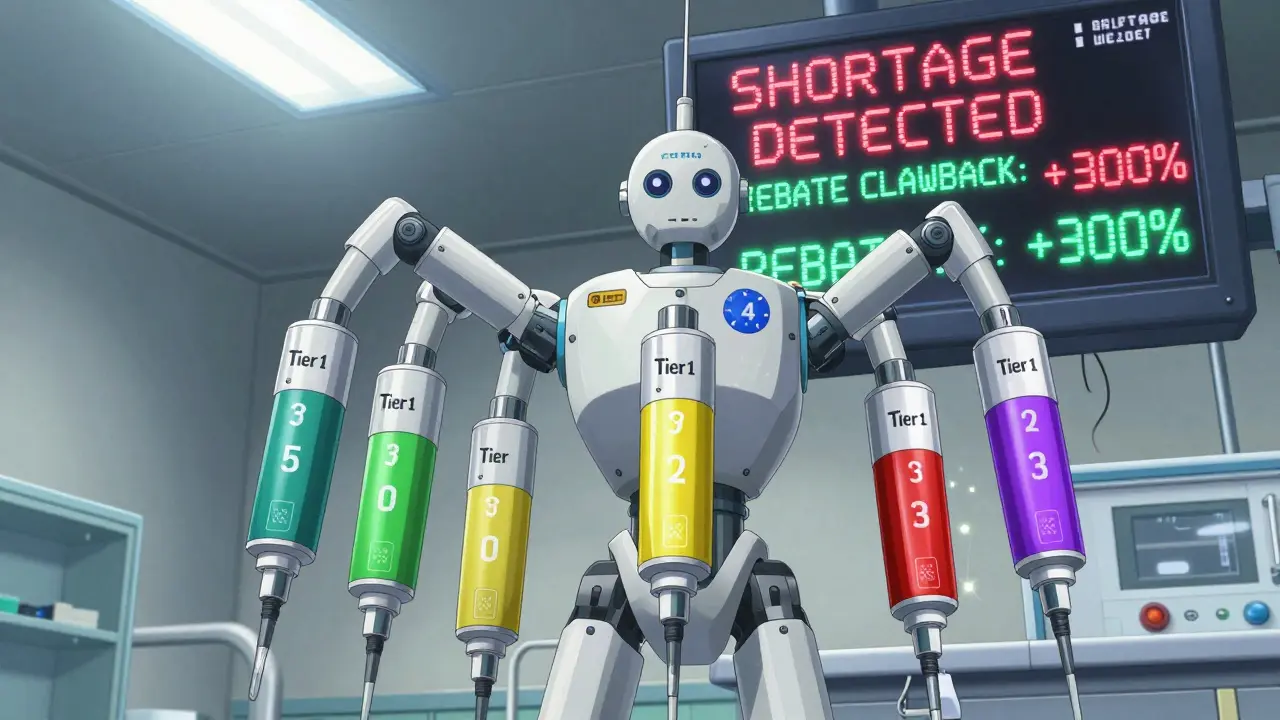
- Tier 1: Preferred generics. Lowest cost to the hospital and patient. Often the first choice for clinicians.
- Tier 2: Non-preferred generics or preferred brands. Moderate cost-sharing. Used when Tier 1 isn’t available or isn’t ideal.
- Tier 3: Non-preferred brands. Higher cost. Require prior authorization.
- Tiers 4-5: Specialty drugs. Often expensive biologics or complex generics. Require step therapy and strict monitoring.
For example, a hospital might place a generic version of metformin in Tier 1 because it’s been used safely for years. But a newer generic version of a blood thinner might sit in Tier 3-until enough data shows it’s as safe as the brand.
Why Hospital Formularies Are Different from Retail
Medicare Part D plans must include at least two drugs in each major therapeutic category. Hospitals don’t have that rule. They can-and often do-limit choices to one or two options per class. Why? Because in a hospital, you need consistency.
Imagine a nurse giving 10 different versions of insulin to 10 patients. One has a different buffer, another a different preservative. Small differences can lead to big mistakes. Hospitals reduce that risk by standardizing. A 2022 study found that 78% of academic medical centers use closed formularies-meaning almost no outside drugs are allowed without special approval. Compare that to commercial health plans, where only 42% use closed formularies.
Hospitals also use tools retail pharmacies can’t: quantity limits, mandatory step therapy, and pre-authorization triggers built into electronic health records. If a doctor tries to order a non-formulary drug, the system flags it. The pharmacist reviews it. The P&T committee is notified. This level of control is why hospitals can reduce drug spending by 20% or more-when done right.
The Hidden Cost of Cheap Generics
It’s tempting to think: cheaper drug = better deal. But that’s not always true.
In 2023, 84% of hospital pharmacists reported at least one critical shortage of a generic drug. When that happens, hospitals scramble. They buy the same drug from a different manufacturer-at 3x the price. Or they use a brand-name drug instead, which costs 10x more. The savings from choosing generics vanish overnight.
And then there are rebates. A manufacturer might offer a 40% rebate on a generic, making it look like the cheapest option. But if that rebate is tied to a contract that requires the hospital to use only that drug for a year, and a better option comes out six months later, the hospital is stuck. Dr. Emily Chen at Massachusetts General Hospital says, “The economic calculus for generics has shifted. The lowest list price doesn’t always mean lowest net cost.”
At Mayo Clinic, they avoided this trap by creating a therapeutic interchange program. They didn’t just swap brands for generics. They built protocols: monitoring, training, documentation. The result? $1.2 million in annual savings-with no drop in patient outcomes.

What’s Changing in 2025 and Beyond
Several forces are reshaping how hospitals choose generics:
- Transparency laws: Starting January 2025, new federal rules will require drug manufacturers to disclose rebate structures. This will expose hidden costs and force formularies to make decisions based on real net prices, not list prices.
- Complex generics: The FDA’s GDUFA III program is investing $4.3 million annually to improve approval of complex generics-like inhalers and injectables. By 2026, more of these will be available, giving hospitals better options.
- Pharmacogenomics: 28% of academic medical centers now use genetic testing to guide generic selection. For example, a patient with a specific gene variant might respond poorly to one generic version of a blood thinner but well to another. Formularies are starting to factor this in.
- Drug shortages: With 298 active generic shortages in late 2023-the highest ever-hospitals are building flexible formularies. They’re keeping backup options, even if they’re more expensive, just to avoid care disruptions.
What It Takes to Get It Right
Successful formularies don’t happen by accident. They require:
- At least 50% clinical pharmacists on the P&T committee
- Quarterly reviews of new generics within 90 days of FDA approval
- Formal AMCP dossiers for every new drug submission-complete with clinical studies, pharmacology, and cost analysis
- Integration of formulary alerts into electronic health records
Yet only 37% of hospitals have fully automated alerts. That means 15-20% of prescriptions still violate formulary rules-because no one caught them. Training is another issue. New P&T members often take 6-9 months to become competent in evaluating bioequivalence studies and rebate structures.
There’s no magic formula. But the best hospitals combine data, clinical judgment, and real-world feedback. They don’t just look at price tags. They watch what happens to patients. They track lab results, readmission rates, and nursing workload. Because in the end, the goal isn’t to save money. It’s to give patients the safest, most effective care-at a sustainable cost.
Why do hospitals reject generic drugs approved by the FDA?
FDA approval only confirms that a generic has the same active ingredient and meets basic bioequivalence standards. But hospitals need more. They look at how the drug performs in real patients-especially those with complex conditions like kidney failure or sepsis. Some generics have different inactive ingredients, delivery systems, or stability profiles that affect absorption or safety. A drug that works fine in a healthy volunteer might cause issues in an ICU patient. Hospitals reject generics that haven’t been proven safe and effective in their specific clinical setting.
Are generic drugs always cheaper than brand-name drugs in hospitals?
Not always. While generics typically cost less upfront, hidden factors can flip the numbers. Manufacturer rebates, service fees, and contract terms can make a supposedly cheap generic more expensive in net cost. Also, if a generic has supply issues, hospitals may have to buy it at a premium from another source. In some cases, switching to a generic requires extra monitoring, nursing time, or lab tests-which can offset savings. The real question isn’t ‘What’s the list price?’ It’s ‘What’s the total cost of use?’
How do hospital formularies handle drug shortages?
Hospitals prepare for shortages by keeping backup options-even if they’re more expensive. Some maintain a list of alternative generics or brand-name drugs that can be used if the primary option runs out. Others use real-time shortage alerts from the FDA and ASHP to switch formulary status quickly. When a shortage hits, the P&T committee may temporarily approve a non-formulary drug, but only after reviewing safety and cost. The goal is to avoid treatment delays without creating long-term financial strain.
Can patients request non-formulary drugs in the hospital?
Patients can ask, but they rarely get what they want. Hospitals prioritize safety and cost-efficiency over individual preference. If a drug isn’t on the formulary, the doctor must justify its use with clinical evidence. The pharmacy team reviews the request, and the P&T committee may need to approve it. In most cases, the hospital will use a formulary alternative that’s just as effective. The exception is if no formulary option exists-for example, a rare condition with no approved generic.
What role do pharmacists play in formulary decisions?
Pharmacists are the backbone of formulary decisions. They analyze clinical data, review bioequivalence studies, track drug shortages, and calculate net costs after rebates. At least half of every P&T committee must be pharmacists. They’re the ones who spot subtle differences between generics-like how one version of an inhaler delivers medication differently than another. Without their expertise, hospitals risk choosing drugs that look cheap but cause more harm-or more cost-down the line.





trudale hampton
March 20, 2026 AT 18:24Really solid breakdown. I've seen hospitals get so obsessed with cost-cutting that they forget the human side of it. One time, a med swap led to a patient having a seizure because the generic didn't absorb right. No one checked the bioequivalence data properly. We ended up spending more on extra monitoring than we saved. Bottom line: it's not about the cheapest pill-it's about the safest one.
Pharmacists are the real MVPs here. They're the ones reading the fine print while everyone else is chasing budgets.
Shaun Wakashige
March 22, 2026 AT 12:37lol at hospitals thinking they're so smart. generics are generics. if the FDA says it's good, why are we overcomplicating this? 🤷♂️
Paul Cuccurullo
March 24, 2026 AT 02:54The elegance of this system lies not in its complexity, but in its humility. Hospitals, unlike retail pharmacies, operate under the sacred principle that patient safety is non-negotiable. The P&T committee doesn't just weigh costs-they weigh consequences. One poorly chosen generic can cascade into a chain of harm: longer hospital stays, increased nurse workload, avoidable readmissions. And yet, we still treat this like a spreadsheet exercise.
True stewardship means accepting that sometimes, the right drug isn't the cheapest. It's the one that doesn't make someone worse while trying to make them better.
Solomon Kindie
March 24, 2026 AT 20:53so like... if the drug works same why not just go cheap right? but then u got all these rebates and contracts and its like a maze and then someone says oh wait this one has different excipients and now im confused
also why do we even have tiers? why not just pick the best one and be done? its like choosing between 3 identical sneakers but one has a 5 cent difference in stitching and now we need a committee
also i think we forgot that patients are people not data points
also i think the fda is corrupted
also i think the pharmaceutical industry is running the show
also i think we need more transparency
also i think this whole system is broken
Natali Shevchenko
March 26, 2026 AT 03:44I’ve been on a P&T committee for six years, and what strikes me isn’t the science-it’s the silence. The quiet moments between meetings when someone says, ‘We’ve never had a problem with this generic before,’ and no one checks if that’s true. We rely on habit, not data. We pick what’s familiar, not what’s optimal.
And then, when a patient has a reaction, we say, ‘It’s an outlier.’ But what if it’s not? What if we’ve been blind to the subtle differences because we’re too busy chasing savings?
The real innovation isn’t in new drugs. It’s in asking better questions. Not ‘How much does it cost?’ but ‘What does it cost to do nothing?’
Johny Prayogi
March 26, 2026 AT 21:13YES. This. Finally someone gets it. 🙌
My hospital just switched to a new generic insulin last year. Thought we were saving cash. Ended up with 3 patients in the ER because of inconsistent absorption. We had to switch back. Cost us double. Now we have a protocol: test glucose trends for 14 days after any new generic. No more guessing.
Pharmacists = unsung heroes. Let’s give them more power, not less.
Chris Dwyer
March 26, 2026 AT 21:51Love this. So many people think hospital formularies are just about saving money, but it’s way deeper than that. It’s about consistency. Imagine being a nurse and having to memorize 10 different ways to give insulin. That’s not efficiency-that’s a waiting disaster.
The fact that hospitals standardize like this? Genius. It’s not about control. It’s about protection.
Also, shoutout to the pharmacists who actually read the dossiers. You guys are the real doctors of the system.
Timothy Olcott
March 26, 2026 AT 23:44americans think they're so smart with their committees and tiers but other countries just pick the drug and move on. why do we need 5 people in a room arguing over excipients? it's a pill. not a rocket ship. we're overengineering healthcare and it's killing us. also why is the fda even involved if hospitals don't even use their approval? sounds like bureaucracy on steroids
Desiree LaPointe
March 27, 2026 AT 00:57Oh, how quaint. A hospital ‘formulary’-as if this is some noble, clinical endeavor. Let’s be honest: it’s a corporate procurement exercise disguised as medical science. The real goal? Maximize rebate capture. The ‘clinical outcomes’? A footnote. The ‘safety’? A marketing slide.
And yet, we still pretend this isn’t a game of financial chess where patients are pawns. The fact that you need a Ph.D. in contract law just to prescribe a generic? That’s not innovation. That’s institutionalized absurdity.
Jackie Tucker
March 28, 2026 AT 04:36It’s fascinating how we’ve turned pharmacology into a labyrinth of rebates, tiers, and bureaucratic rituals. We’ve forgotten that medicine was once about healing, not accounting.
And yet-we still cling to the myth that this system is ‘evidence-based.’ The evidence? That 78% of hospitals use closed formularies because they’re easier to manage, not because they’re better.
The real question: Are we optimizing for patient outcomes-or for audit readiness?
Thomas Jensen
March 29, 2026 AT 17:27you think this is about patient safety? think again. the real reason they control the formulary is so they can sell you data to drug companies. every time a drug gets rejected, it's because the manufacturer didn't pay enough. the fda is in on it. the p&t committee? they're paid consultants. the 'clinical outcomes'? fabricated. they're all part of the same network. i know this because i used to work in pharmacy IT. they track every prescription. they know who you are. they know what you took. and they sell it. this isn't medicine. it's surveillance capitalism.
matthew runcie
March 30, 2026 AT 13:27Good read. Makes me appreciate the work pharmacists do behind the scenes. Not flashy, but it saves lives. Just wish more hospitals had enough of them on the committee.
shannon kozee
March 30, 2026 AT 17:14Exactly why we need more clinical pharmacists on P&T teams. Not admins. Not marketers. Real pharmacists who’ve worked the floor. They know what happens when a generic behaves differently in a septic patient. That’s the insight no spreadsheet can capture.
Nicole James
March 31, 2026 AT 04:28And yet... who’s really behind these decisions? The P&T committee? Or the pharmaceutical reps who bring them coffee, sponsor their CMEs, and whisper, 'We have a rebate for this drug...'? The FDA approves, but the real power? It’s in the contract room. The hidden rebate. The exclusive deal. The ‘free’ software system that tracks every prescription and feeds data back to the manufacturer. We pretend this is science. But it’s all finance. And we’re the ones paying the price.
Nishan Basnet
April 1, 2026 AT 19:12This is beautiful. A hospital formulary isn’t just a list-it’s a promise. A promise that every patient, regardless of income or background, will get the safest, most effective drug-not the cheapest one, not the one with the biggest rebate, but the one that actually works in the messy reality of a sick human body.
Pharmacists are the unsung guardians of this promise. They don’t get parades. But they’re the ones who stop the mistake before it happens.