Opioid Hormone Risk Calculator
Opioids can significantly impact hormone systems after 90 days of use. This tool estimates your risk of developing hormone disruption based on your opioid dosage and duration of use.
When someone starts taking opioids for chronic pain, they’re often focused on relief - not on what’s happening inside their body. But long-term use doesn’t just numb pain. It quietly shuts down key hormone systems, leading to problems many doctors don’t talk about: low libido, erectile dysfunction, missed periods, and deep fatigue. These aren’t rare side effects. They’re common, predictable, and often ignored.
How Opioids Break Your Hormone System
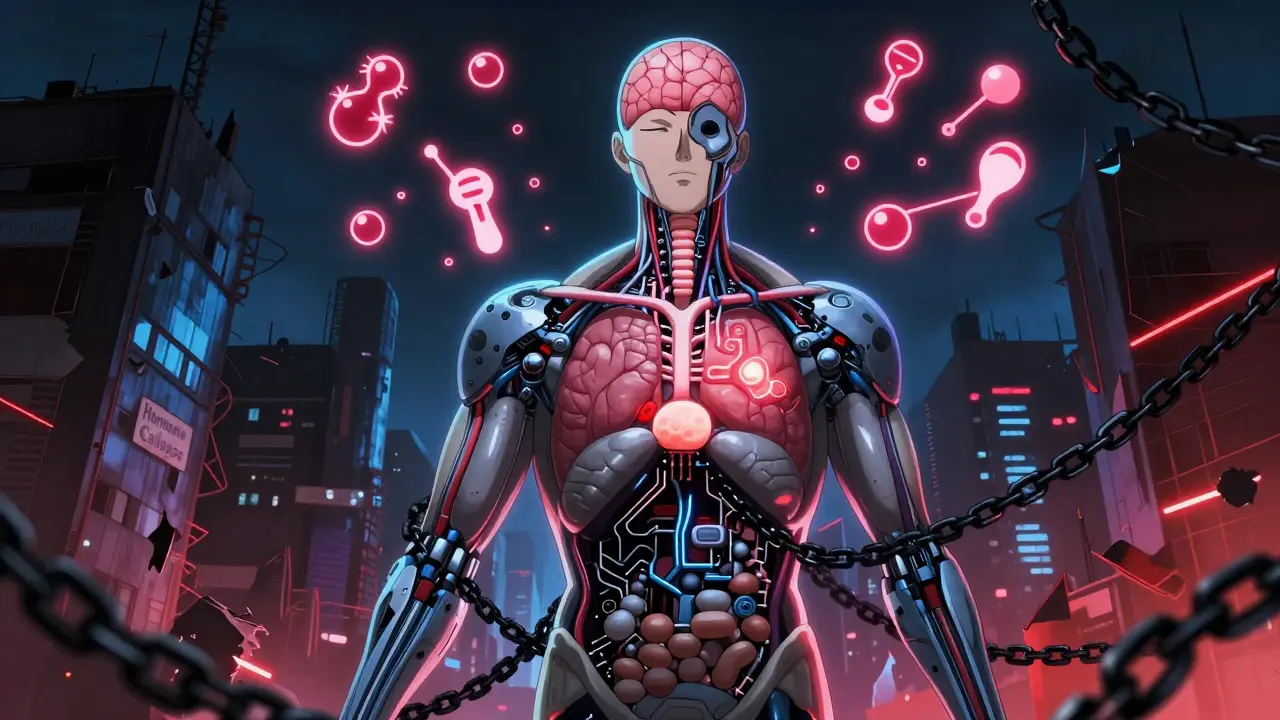
Opioids like oxycodone, fentanyl, and morphine don’t just bind to pain receptors. They also interfere with the hypothalamic-pituitary-gonadal (HPG) axis - the body’s master control center for sex hormones. This system tells your brain to signal the testes or ovaries to produce testosterone and estrogen. When opioids block the release of gonadotropin-releasing hormone (GnRH), the whole chain collapses.
Studies show that as little as 60-120 morphine milligram equivalents (MME) per day - a common prescription dose - is enough to start this disruption. Within 30 days, men often see testosterone levels drop by 30-50%. After six months of continuous use, 63% of men develop biochemical hypogonadism, meaning their testosterone falls below 300 ng/dL. For women, the pattern is different. Estradiol levels usually stay steady, but free testosterone drops sharply. This leads to loss of sexual desire, fatigue, and mood changes.
Sexual Dysfunction Is the Visible Side Effect
Low testosterone doesn’t just mean lower energy. It means trouble in the bedroom. Men report erectile dysfunction, reduced sexual thoughts, and complete loss of interest in sex. On Reddit’s r/ChronicPain community, over 200 men shared stories of losing their sex lives after starting opioids. One user wrote: “After two years on oxycodone, my testosterone hit 180. My doctor didn’t test it until I brought it up.”
Women face different but equally real challenges. Nearly 87% of premenopausal women on long-term opioids develop menstrual problems. About 19-67% stop getting periods entirely. Another 33-50% have irregular cycles. These aren’t just inconveniences - they signal deeper hormonal imbalance and can affect fertility, bone density, and mental health.
Why Doctors Miss This
Many patients don’t bring up sexual issues because they’re embarrassed. But doctors rarely ask. A 2023 JAMA Internal Medicine study found only 38% of primary care physicians routinely screen for hormone disruption in patients on long-term opioids. Instead, symptoms get written off as “normal aging” or “depression from pain.”
The Endocrine Society’s 2019 guidelines say this is substandard care. They recommend baseline testosterone testing before starting opioids and follow-up every six months. Yet most clinics don’t follow this. A 2022 survey of 342 women on chronic opioids found that 67% felt their doctors dismissed their sexual symptoms. That gap between evidence and practice leaves thousands suffering in silence.
What Happens When You Compare Opioids to Other Pain Treatments
Opioids aren’t the only painkillers with side effects - but they’re the worst for hormones. Gabapentinoids like pregabalin affect testosterone in only 12% of men. NSAIDs like ibuprofen show almost no hormonal impact at standard doses. Meanwhile, opioids disrupt hormone levels in 21-86% of users, depending on the study.
That’s why major medical groups - including the American Pain Society - now advise against using opioids as first-line treatment for chronic non-cancer pain. Physical therapy, cognitive behavioral therapy, and certain antidepressants like duloxetine have better long-term outcomes and zero hormonal side effects. For severe pain like advanced cancer or post-surgery recovery, opioids still have a place. But for back pain, arthritis, or fibromyalgia? The risks far outweigh the benefits.
What Can You Do? Treatment Options
Fixing opioid-induced hormone problems isn’t complicated - but it takes action. For men, testosterone replacement therapy (TRT) works. Studies show 70-85% of men see improvement in libido, energy, and erectile function when testosterone is restored to normal levels. TRT comes in gels, patches, or injections. But it’s not risk-free - about 15-20% of users develop polycythemia (thickened blood), which requires monitoring.
For erectile dysfunction, drugs like sildenafil (Viagra) or tadalafil (Cialis) help 60-70% of men. But they don’t fix the root cause: low testosterone. That’s why combining TRT with ED meds often works best.
For women, options are scarcer. There’s no FDA-approved treatment for opioid-induced low libido in women. Some doctors use off-label testosterone patches (1-2 mg daily), with small studies showing 50-60% improvement in sexual desire. But research is thin. The bigger issue? Most clinical trials still don’t include enough women to understand how opioids affect them.
The New Hope: Safer Alternatives and Better Protocols
Things are starting to change. In 2023, the FDA approved Belbuca (buprenorphine buccal film), which causes 40% less hormone disruption than traditional opioids in early trials. In March 2024, Cleveland Clinic published data showing that adding low-dose naltrexone (a drug that blocks opioid receptors) to reduced opioid doses improved testosterone levels by 25-35% in 68% of patients - without losing pain control.
The Endocrine Society updated its guidelines in January 2024, now requiring universal testosterone screening for men on long-term opioids. More clinics are starting to use multidisciplinary teams - pain specialists, endocrinologists, and therapists - working together. One patient satisfaction survey found that 82% of people felt better after combining hormone treatment with pain management.
What to Do If You’re on Long-Term Opioids
If you’ve been on opioids for more than 90 days and notice:
- Loss of sex drive
- Erectile dysfunction
- Unexplained fatigue
- Mood swings or depression
- Missed or irregular periods
Don’t wait. Ask your doctor for a testosterone blood test - even if you’re a woman. Request a full hormone panel: total testosterone, free testosterone, LH, FSH, and cortisol. If levels are low, ask if TRT or other interventions are an option. Don’t be afraid to push. Many patients who got help say their lives improved dramatically once their hormones were fixed.
And if you’re thinking of quitting opioids - don’t do it alone. Withdrawal can be brutal. 73% of people who try to stop without medical supervision go back to their old dose within 90 days. Work with a pain specialist who understands both opioid dependence and endocrine health.
The Bigger Picture
This isn’t just about sex. It’s about quality of life. Hormone disruption from opioids leads to bone loss, muscle wasting, depression, and reduced resilience to stress. It’s a hidden crisis in chronic pain care - one that’s costing patients their energy, relationships, and self-worth.
The market for non-opioid pain treatments is growing fast, expected to hit $59 billion by 2027. The testosterone therapy market is booming too, partly because of opioid-induced hypogonadism. But money alone won’t fix this. It takes awareness, screening, and courage - from doctors and patients alike.
The science is clear. The solutions exist. What’s missing is the conversation. Start it.
Can long-term opioid use cause low testosterone in men?
Yes. Studies show that 63% of men on chronic opioid therapy develop biochemical hypogonadism, defined as total testosterone below 300 ng/dL. This happens because opioids suppress the hypothalamic-pituitary-gonadal axis, reducing the signals that tell the testes to produce testosterone.
Do women also experience hormone problems from opioids?
Yes. While estrogen levels usually stay normal, women on long-term opioids often have reduced free testosterone, leading to low libido, fatigue, and mood changes. Up to 87% develop menstrual problems, including amenorrhea (no periods) in 19-67% of cases and irregular cycles in 33-50%.
Is testosterone replacement therapy safe for men on opioids?
Yes, when monitored properly. TRT improves sexual function, energy, and mood in 70-85% of men with opioid-induced hypogonadism. However, it carries risks like polycythemia (thickened blood) in 15-20% of users, so regular blood tests are required. TRT does not interfere with pain control and can be used alongside opioids.
Why don’t doctors test for hormone levels in opioid patients?
Many doctors don’t ask because they’re focused on pain control, and patients often don’t bring up sexual symptoms due to embarrassment. A 2023 study found only 38% of primary care physicians routinely screen for opioid-induced endocrinopathy - even though guidelines have recommended it since 2019.
Are there alternatives to opioids that don’t affect hormones?
Yes. Non-opioid treatments like physical therapy, cognitive behavioral therapy, and certain antidepressants (e.g., duloxetine) have no known hormonal side effects. Gabapentinoids affect testosterone in only 12% of users, compared to 63% with opioids. NSAIDs like ibuprofen show minimal impact at standard doses.
Can reducing opioid dosage help restore hormone levels?
Yes. Studies show that lowering opioid doses - especially when combined with medications like low-dose naltrexone - can improve testosterone levels by 25-35% in 68% of patients. This approach helps maintain pain control while reversing hormone suppression.
Is it safe to stop opioids cold turkey if I have hormone issues?
No. Withdrawal symptoms can be severe and include nausea, anxiety, muscle pain, and insomnia. About 73% of people who try to quit without medical help return to their previous dose within 90 days. Always work with a pain specialist or addiction medicine provider to taper safely.


Allison Priole
March 22, 2026 AT 10:07Man i read this whole thing and honestly? I didn't even know opioids could mess with your hormones like this. I thought it was just about pain and addiction. My cousin's been on oxycodone for 5 years for her back and she stopped getting her period like 2 years ago. She thought it was stress or something. No one ever told her this could be linked. Kinda scary how much we don't know about these meds.
Also wow 87% of women on long-term opioids get period issues? That's wild. Why isn't this common knowledge? Like if your doctor prescribes you this stuff for 6 months, shouldn't they say hey btw this might kill your sex drive and your cycle? Just saying.
Casey Tenney
March 23, 2026 AT 10:08This is why we need to stop handing out opioids like candy.
Bryan Woody
March 24, 2026 AT 13:36Let me guess - the people who are now crying about hormone damage are the same ones who complained about the opioid crisis being "overblown" a decade ago.
Here's the truth: opioids suppress your endocrine system because they're not meant for chronic non-cancer pain. Period. If you're on 120 MME for 2 years because you didn't do PT or try CBT or get a spine specialist involved? You got what you deserved. The science has been out since 2010. The guidelines have been clear since 2016. You didn't listen. Now you're mad your libido died? Congrats. You're not a victim. You're a case study.
And for the women reading this: yes your free testosterone drops. No there's no FDA-approved fix. That's because the pharma companies never bothered to study women properly. Classic. But guess what? You can still ask for off-label patches. You can still push. Stop waiting for permission. Your body doesn't care about bureaucracy.
And yes TRT works. 70-85% improvement? That's not magic. That's biology. You want your energy back? Go get tested. Stop Googling "why am I so tired" and start Googling "testosterone panel near me". I'm not your doctor. But I'm your wake-up call.
Chris Dwyer
March 25, 2026 AT 13:58Hey I just wanna say this post saved my life. I was on fentanyl patches for 18 months after a car wreck. Lost all interest in sex, felt like a zombie, couldn't sleep. My wife was about to leave me. I didn't even realize it was the meds. I thought I was just depressed.
Then I found this article. Went to my doc, asked for a testosterone test. My levels were at 210. He was shocked I hadn't been tested before. Put me on TRT. Three months later? I'm back. Energy, libido, mood - all back. I even started working out again.
To anyone on long-term opioids: don't wait. Get tested. Talk to someone. You're not broken. Your body just got tricked. And it can heal.
Also side note - low dose naltrexone thing? That's next level. I'm gonna try that next. Seriously, this stuff matters.
Timothy Olcott
March 27, 2026 AT 00:15USA is falling apart 😭
Doctors giving out opioids like candy 🍬
Now people are losing their manhood 💔
Why no one listens to science? 🤦♂️
Get off the drugs and lift weights 🏋️♂️
Fix your life before it's too late 💪
Johny Prayogi
March 27, 2026 AT 01:21Just want to add - I'm a nurse in a pain clinic. We started doing routine testosterone checks for men on opioids 2 years ago. Since then, we've seen a 40% drop in patients quitting treatment because "they feel broken". Once they know it's fixable, they stay. It's not about giving up opioids. It's about treating the whole person.
Also for women - we've had success with off-label testosterone gel. Not perfect, but better than nothing. The real win? When patients stop feeling ashamed. That's the first step.
Nishan Basnet
March 27, 2026 AT 16:41As someone from India where opioid use is far less common but still rising, this is both fascinating and terrifying. The cultural silence around sexual health makes this even more dangerous here. In rural clinics, patients rarely mention fatigue or low desire - they're told to "just bear it". Meanwhile, Western medicine has the data but not the will to act. The gap between knowledge and practice is not just American - it's global.
What's missing isn't science. It's empathy. It's the willingness to ask the uncomfortable question: "Has your sex life changed?"
I hope this post reaches more than Reddit. It should be in every primary care waiting room. Because this isn't a niche issue. It's a silent epidemic that turns pain into isolation.
Sandy Wells
March 28, 2026 AT 23:30While the data presented is compelling, one must consider the broader context of pharmaceutical influence and the erosion of holistic care. The medical establishment's reliance on pharmacological intervention over behavioral and physical modalities is a systemic failure. The notion that hormone replacement therapy is a viable solution suggests a continuation of symptomatic treatment rather than root-cause resolution. Furthermore, the normalization of testosterone supplementation as a corrective measure for iatrogenic harm reflects a troubling commodification of bodily function. One must question whether the current paradigm prioritizes patient autonomy or pharmaceutical profitability. The answer, as always, lies in the margins of the ledger.