
Pharmacovigilance Signal Calculator
How Social Media Pharmacovigilance Works
Social media monitoring detects potential drug safety signals, but most posts are noise. This calculator shows why.
Based on article data: 68% of social media mentions are irrelevant. For rare drugs, false positives reach 97%.
Results
Real-world insight: In the diabetes drug case mentioned in the article, social media detected signals 47 days earlier than formal reports—but only after filtering out 68% of irrelevant mentions.
Every year, millions of people take medications that work perfectly for most-but cause unexpected side effects in a few. Traditional systems for tracking these reactions, like doctor-submitted reports, catch only 5 to 10% of actual adverse events. That’s where social media pharmacovigilance comes in. Platforms like Twitter, Reddit, and Facebook are now being mined for real-time patient stories, turning casual posts into potential safety signals. But it’s not as simple as scanning hashtags. This isn’t just about finding complaints-it’s about filtering noise, protecting privacy, and turning raw social chatter into reliable data that regulators can act on.
Why Social Media Matters for Drug Safety
Imagine a new diabetes drug hits the market. In clinical trials, it looked safe. But weeks later, users on Reddit start posting about sudden dizziness after taking it. A pharmacist notices the pattern. Within days, the company’s pharmacovigilance team flags it. By the time the first formal report reaches the FDA, the signal has already been detected-47 days earlier. That’s not fiction. It happened in 2023.
Traditional reporting relies on doctors and patients filling out forms. Many don’t. Some forget. Others think it’s not serious. Social media changes that. People talk. They share side effects in real time-no gatekeepers, no forms, no delays. With 5.17 billion people online globally, and spending over two hours a day on social apps, the volume of unfiltered patient experience is massive.
Companies like Venus Remedies used this to spot rare skin reactions to a new antihistamine. The cluster showed up in Instagram comments and health forums. They updated the product label 112 days faster than traditional methods would’ve allowed. That’s life-saving speed.
How It Actually Works Behind the Scenes
It’s not just typing “#headache after taking X drug” into Google. Real social media pharmacovigilance uses AI and natural language processing to dig through millions of posts. Here’s how:
- Named Entity Recognition (NER) pulls out key details: drug names, doses, symptoms, and patient identifiers. It can tell the difference between “I took 50mg of lisinopril” and “I saw a commercial for lisinopril.”
- Topic Modeling finds patterns even when people don’t use medical terms. Someone might say “I feel like my brain is foggy” instead of “cognitive impairment.” The system learns those phrases over time.
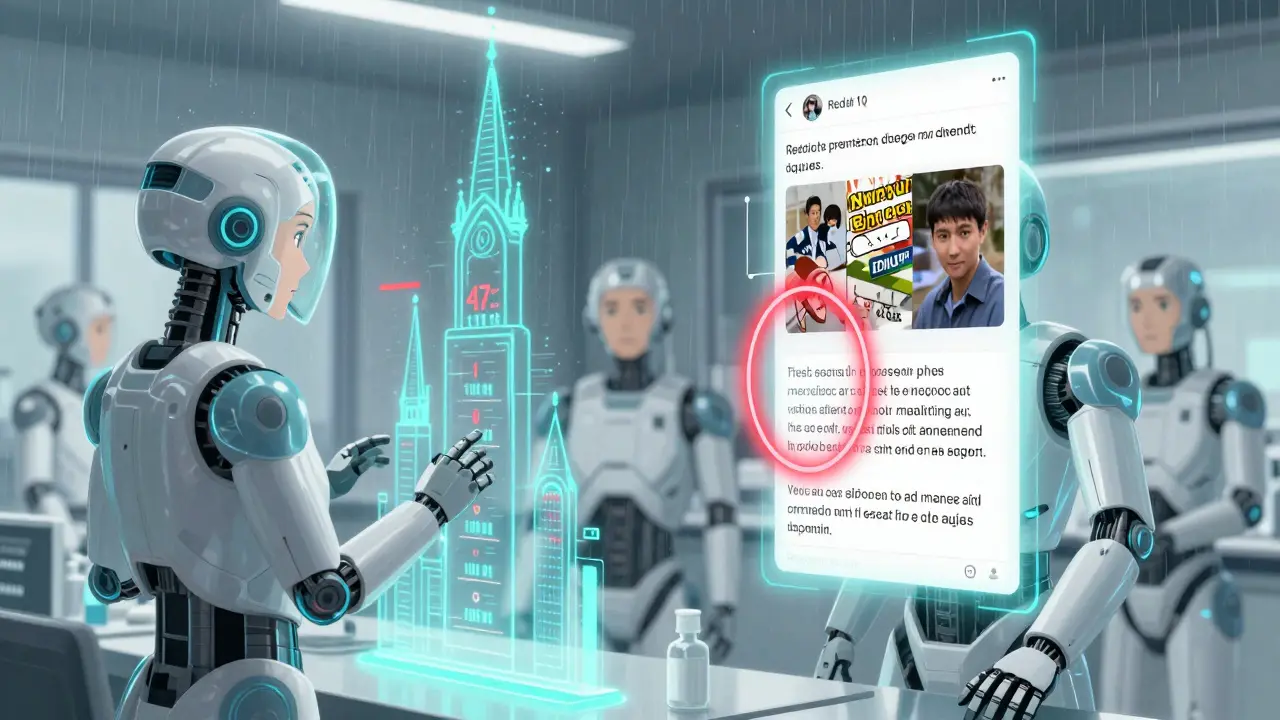
- AI Filters weed out junk. 68% of mentions turn out to be irrelevant-jokes, misinformation, or unrelated symptoms. Only 3.2% of all social media reports meet the bar for formal review.
Major pharma companies now use AI to process around 15,000 posts per hour. Accuracy? About 85%. That sounds high-but it still means 1 in 7 reports needs human review. And that’s where the real work begins.
The Big Problems: Noise, Privacy, and Bias
Not every post is real. Not every patient is who they say they are. And not every symptom is caused by the drug.
Here’s the truth: 92% of social media reports lack medical history. 87% don’t mention dosage. 100% can’t be verified. Someone might say they took “10mg of Zoloft” but never saw a doctor. They might have mixed it with alcohol. Or it was a placebo effect. Without lab results or clinical context, it’s guesswork.
Then there’s bias. People who post online are often younger, more tech-savvy, and more likely to be from wealthier countries. Older adults, rural communities, and non-English speakers are underrepresented. That means safety signals from these groups might never surface.
And privacy? Huge concern. Patients share intimate health details-mental health struggles, chronic pain, sexual side effects-without realizing their post could end up in a corporate database. One Reddit user wrote: “I told the world I was suicidal after starting this med. Now my pharmacy gets flagged for ‘high-risk patients.’ I didn’t consent to that.”
When It Works-and When It Doesn’t
It’s not a magic bullet. Social media shines for drugs with huge user bases. If 2 million people take a blood pressure pill, even a tiny percentage of complaints adds up. But for rare medications-say, one used by only 5,000 people a year-it’s useless. The FDA found false positive rates of 97% in those cases. The signal is drowned in noise.
On the flip side, social media caught a dangerous interaction between a new antidepressant and a common herbal supplement. That wasn’t in any clinical trial. No doctor reported it. But dozens of users on r/Pharma described feeling “wired” or “heart racing” after combining the two. That led to a warning label update.
Another win: a new anticoagulant had a spike in reports of nosebleeds on Twitter. Traditional reports were flat. But the social media data was consistent across regions, languages, and platforms. Regulators investigated-and confirmed a real risk in patients over 75. The label was updated. Lives were saved.
What the Experts Really Think
Dr. Sarah Peterson at Pfizer calls social media a “valuable supplementary stream.” She says it’s best for catching early warnings on widely used drugs. But she’s clear: “It doesn’t replace traditional systems. It complements them.”
Professor Michael Chen, who led the WEB-RADR project, was more skeptical. After analyzing 24 months of data, he found limited value for most drugs. “We need rules,” he said. “Not just tools.”
The FDA and EMA agree. In 2022, the FDA issued formal guidance saying social media data can be used-but only if validated. In 2024, the EMA made it mandatory for companies to document their social media monitoring strategies in safety reports. This isn’t optional anymore. It’s part of compliance.
How Companies Are Doing It Right
Successful programs don’t just scrape tweets. They build systems. Here’s what works:
- Monitoring 3-5 key platforms: Twitter, Reddit, Facebook, Instagram, and niche health forums like PatientsLikeMe.
- Using multilingual AI tools-63% of companies struggle with non-English posts.
- Implementing three-stage human review: AI flags → junior analyst checks → senior pharmacovigilance expert approves.
- Partnering with platforms. Facebook and IMS Health teamed up in 2022 to cut duplicate reports by 89%.
Training is brutal. Staff need 87 hours of specialized education just to tell the difference between a real side effect and someone’s bad day. Many companies hire data scientists, not just pharmacists, to run these teams.
The Future: AI, Regulation, and Trust
The market for social media pharmacovigilance is exploding-from $287 million in 2023 to an estimated $892 million by 2028. Why? Because regulators are pushing for it. 78% of big pharma companies increased their budgets after the EMA’s 2022 update.
But the biggest leap is coming from AI. In March 2024, the FDA launched a pilot with six companies to test new validation tools. Goal? Cut false positives below 15%. That’s ambitious. But if they hit it, social media could become a trusted source-not just a supplement.
The future isn’t about replacing doctors or clinical trials. It’s about listening to patients in real time, without losing rigor. The best systems will blend social data with electronic health records, pharmacy databases, and traditional reports. Think of it as a safety net woven from many threads.
For now, it’s messy. It’s imperfect. But it’s real. And it’s changing how drugs are monitored-for the better, if we get the rules right.
Can social media really detect dangerous drug side effects before regulators?
Yes. In documented cases, social media has flagged potential safety signals up to 47 days before the first formal report reached regulatory agencies. This happened with a new diabetes medication in 2023, where patient posts on Reddit and Twitter revealed a pattern of dizziness that wasn’t evident in clinical trials. While these aren’t confirmations, they serve as early warnings that trigger deeper investigation.
Is it legal for drug companies to monitor social media for side effects?
Yes, but with strict rules. The FDA and EMA both require companies to document their monitoring methods and validate any data used in safety assessments. While companies can collect public posts, they must protect patient privacy and avoid using data from private accounts. In 2024, the EMA made it mandatory to include social media strategies in periodic safety reports.
Do patients know their social media posts are being monitored?
Most don’t. While posts on public platforms are legally accessible, many users aren’t aware their health comments could be harvested by pharmaceutical companies. This raises ethical concerns. Some experts argue it’s a duty to use this data to improve safety, but others warn it violates patient privacy expectations. Transparency is improving, but it’s still not standard practice.
Why do social media reports have such high false positive rates?
Because social media is full of noise. People report symptoms without context-maybe they drank alcohol, skipped meals, or have another condition. Dosage info is missing 87% of the time. Patient identities can’t be verified. AI can filter out obvious spam, but 68% of potential reports still need manual review. For rare drugs, the signal-to-noise ratio is so bad that false positives hit 97%.
What’s the biggest limitation of social media pharmacovigilance?
The biggest limitation is data quality. Without medical history, lab results, or verified dosing, it’s impossible to confirm causality. Social media gives you clues-not proof. It’s best used alongside traditional reporting systems, not as a replacement. The most successful programs treat it as an early warning system, not a diagnostic tool.
Are smaller pharmaceutical companies using social media for pharmacovigilance?
Less so. As of 2024, 78% of large pharmaceutical companies use social media monitoring, but adoption drops sharply among smaller firms. The cost of AI tools, training, and compliance is high. Many smaller companies rely on outsourced vendors or stick to traditional reporting. However, as regulatory pressure grows and AI tools become cheaper, adoption is expected to rise across all sizes by 2027.



Patrick Merrell
January 27, 2026 AT 05:01George Rahn
January 27, 2026 AT 09:41Karen Droege
January 28, 2026 AT 05:56Napoleon Huere
January 29, 2026 AT 19:59Shweta Deshpande
January 31, 2026 AT 11:20Shawn Raja
February 1, 2026 AT 03:44Allie Lehto
February 1, 2026 AT 17:46Henry Jenkins
February 2, 2026 AT 20:42Ashley Karanja
February 4, 2026 AT 03:35Jessica Knuteson
February 6, 2026 AT 03:09Robin Van Emous
February 7, 2026 AT 03:35