
Vitamin K Consistency Calculator
Keep Your INR Stable
Calculate how consistent your vitamin K intake is and see the potential impact on your warfarin therapy. Consistency matters more than restriction.
When you're taking warfarin, your diet isn't about eating healthy in the usual sense-it's about eating the same way every day. A sudden plate of kale or a week of spinach smoothies can throw off your blood clotting time, and that’s not something you want to risk. The key isn’t avoiding vitamin K-rich foods. It’s consistency. That’s the one rule that matters more than any other when you’re on this medication.
Why Vitamin K Matters with Warfarin
Warfarin works by blocking a chemical in your body that uses vitamin K to help your blood clot. Think of it like turning down a faucet: warfarin slows the flow so clots don’t form where they shouldn’t. But if you suddenly turn the faucet back up-by eating a lot more vitamin K-your blood starts clotting faster again. That’s dangerous if you’re on warfarin for atrial fibrillation, a replaced heart valve, or a past blood clot.
The measure doctors use to track this is called INR (International Normalized Ratio). A normal INR for someone on warfarin is usually between 2.0 and 3.0. Go below 2.0? You’re at higher risk for clots. Go above 3.0? You risk bleeding. And guess what? One of the top three reasons INR swings out of range is a change in vitamin K intake. Not skipping a dose. Not drinking alcohol. Not another medication. Just your food.
What Foods Have the Most Vitamin K?
Vitamin K1 (phylloquinone) is the main type in food, and it’s mostly in green leafy vegetables. Here’s what’s packed with it:
- Cooked kale: over 1,000 mcg per cup
- Cooked spinach: nearly 900 mcg per cup
- Swiss chard (raw): almost 300 mcg per cup
- Brussels sprouts: 156 mcg per cup
- Broccoli: 85 mcg per cup
- Asparagus: 70 mcg per cup
- Green tea: 41-88 mcg per serving
Other sources include soybean oil, canola oil, and some fermented foods like natto (which has vitamin K2). But if you’re eating typical Western meals, you’re getting 90% of your vitamin K from plants-especially greens.
For reference, the general recommended daily intake for adults is 90-120 mcg. But if you’re on warfarin, it doesn’t matter if you eat 100 mcg or 200 mcg. What matters is that you eat the same amount every day.
Consistency Beats Restriction
Many people hear “vitamin K affects warfarin” and assume they need to cut out greens completely. That’s a mistake. Avoiding them entirely can make your INR harder to control, not easier. Studies show patients who eat a steady amount of vitamin K-rich foods have more stable INR levels than those who eat almost none.
The American Heart Association, the Anticoagulation Forum, and the Mayo Clinic all agree: don’t avoid. Just balance. Eat the same amount of greens, the same way, most days. If you normally have a small side of steamed broccoli with dinner, keep doing that. If you rarely eat greens, don’t suddenly start having a kale salad every day.
One study found that patients who kept their daily vitamin K intake within 20% of their usual amount stayed in therapeutic INR range 78% of the time. Those with wild swings? Only 42%.
Real-Life Traps and How to Avoid Them
Here’s what actually trips people up:
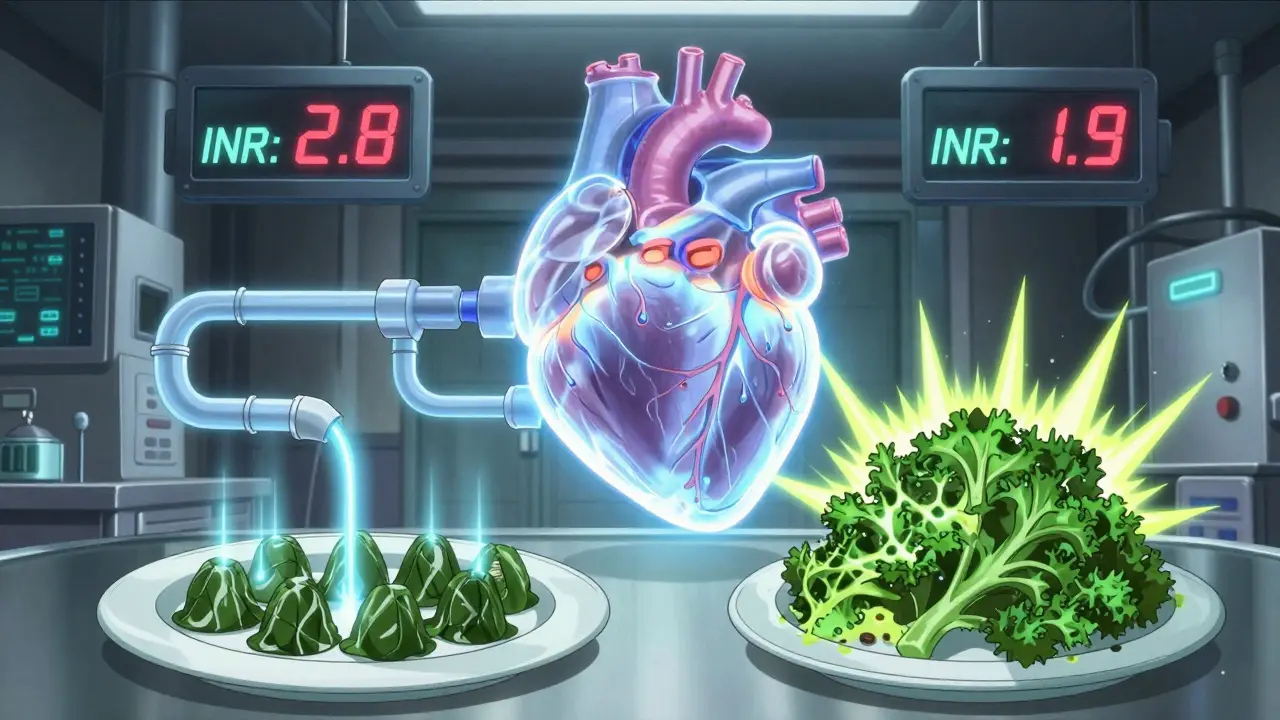
- Spring cleanse diets - People jump on green smoothies, juicing, or detox plans. One patient’s INR dropped from 2.8 to 1.9 after three days of daily kale salads. His warfarin dose had to be increased by 15%.
- Restaurant meals - A salad with spinach, broccoli, and olive oil can have 500+ mcg of vitamin K. If you’re used to eating plain rice and chicken, that’s a huge jump.
- Seasonal changes - Winter means fewer fresh greens. Spring brings an overload. If you go from eating no greens in January to three cups of spinach in April, your INR will shift.
- Supplements - Multivitamins with vitamin K can throw things off if you start taking them-or stop-without telling your doctor.
One man in the Stop the Clot registry kept his INR stable for eight years by eating exactly two cups of cooked spinach every Tuesday and Thursday. No more. No less. That’s the kind of routine that works.
How to Stay on Track
Here’s how to make consistency easier:
- Measure your greens - Use a measuring cup. Don’t guess. A “handful” of spinach can be 1 cup or 3 cups. That’s a 200% difference in vitamin K.
- Keep a food diary - Write down what you eat, especially greens, oils, and supplements. You don’t need to log everything, but track vitamin K sources for a few days each week.
- Stick to your usual routine - If you eat spinach on weekends, keep doing it. If you don’t, don’t start.
- Check supplements - If you take a multivitamin, make sure it has the same amount of vitamin K every day. If it doesn’t, switch brands or skip it.
- Plan ahead for changes - If you’re going on vacation or trying a new diet, talk to your doctor or anticoagulation clinic first. They can adjust your dose before the change hits.
Patients who get personalized advice from a registered dietitian who specializes in anticoagulation reach therapeutic INR levels 85% of the time-much higher than those who don’t.
What to Do If You Eat Too Much (or Too Little)
Accidents happen. You ate a big salad at lunch, or you skipped veggies all week because you were sick.
If you eat a meal with way more vitamin K than usual (say, double your normal amount), don’t panic. Don’t skip your warfarin. But do call your provider. They might suggest a small dose increase the next day.
If you eat almost no vitamin K for several days, your INR might rise. Again, don’t change your dose on your own. Get tested. Your INR will tell you what to do.
For extreme cases-like an INR above 10 with no bleeding-doctors may give a small oral dose of vitamin K (1-2.5 mg) to bring it down safely. But this is only done under medical supervision.

What About Other Foods and Drinks?
While vitamin K is the biggest dietary factor, other things can interfere:
- Alcohol - Heavy drinking can raise INR. Stick to moderate amounts (1 drink/day).
- Green tea - It has vitamin K, but also compounds that may affect how warfarin works. If you drink it daily, keep the amount steady. Don’t go from 1 cup to 5.
- Herbal supplements - Garlic, ginkgo, ginger, and St. John’s wort can increase bleeding risk. Avoid them unless your doctor says it’s safe.
- Cruciferous vegetables - Broccoli, cabbage, cauliflower. They’re high in vitamin K, but they’re not dangerous if you eat them consistently.
The bottom line: vitamin K is the main dietary player. Everything else is secondary.
Monitoring Is Your Safety Net
You still need regular INR tests-even if you’re eating the same thing every day. Most people on stable warfarin get tested every 3-4 weeks. But if you’ve made a dietary change, get tested sooner. Your provider might ask you to come in within a week.
Some clinics now use apps or digital logs to track food and INR trends. If yours offers it, use it. It helps spot patterns before they become problems.
Final Thought: You’re in Control
Warfarin isn’t about fear. It’s about routine. You don’t have to give up your favorite foods. You don’t have to eat bland meals. You just have to keep your vitamin K intake steady. That’s it.
One woman in Bristol told her nurse she’d been eating a cup of cooked spinach every other day for 12 years. Her INR was always perfect. She didn’t change a thing. That’s the power of consistency.
Your body doesn’t need to be perfect. It just needs to be predictable. And that starts with your plate.
Can I eat spinach if I’m on warfarin?
Yes, you can-and you should, if you’re already eating it. The key is to eat about the same amount every day. If you’ve never had spinach, don’t start suddenly. If you eat a cup every Tuesday and Thursday, keep doing that. Consistency matters more than avoiding it.
What happens if I eat too much vitamin K one day?
A single high-vitamin K meal won’t cause immediate harm, but it can lower your INR over the next few days. You might not notice symptoms, but your blood will clot faster. Call your clinic or provider. They may adjust your warfarin dose slightly. Don’t skip your next INR test.
Should I avoid all green vegetables?
No. Avoiding greens entirely can actually make your INR harder to control. Studies show patients who eat consistent amounts of vitamin K-rich foods have more stable blood levels than those who avoid them. The goal is balance-not elimination.
Does cooking affect vitamin K levels?
Cooking doesn’t destroy vitamin K, but it can change the volume. For example, 1 cup of raw spinach shrinks to about 1/2 cup when cooked. That means cooked spinach has more vitamin K per cup than raw. Always measure after cooking if that’s how you eat it. Use the same method every time.
Can I take a vitamin K supplement?
Only if your doctor or dietitian says yes-and only if you take the same dose every day. Many multivitamins contain vitamin K, and switching brands or stopping them suddenly can affect your INR. If you’re taking one, stick with it. If you’re not, don’t start.
How often should I get my INR checked?
If your INR is stable, every 3-4 weeks is typical. But if you’ve changed your diet, started a new medication, or gotten sick, get tested sooner-sometimes within a week. Your provider will tell you when to come in.
Is there a perfect amount of vitamin K I should eat daily?
There’s no magic number. The goal is consistency, not a specific amount. Most people on warfarin do well with 75-100 mcg per day, but what matters is that you eat the same amount every day-not whether it’s exactly 90 or 110.





Morgan Dodgen
March 9, 2026 AT 07:38Look, I get it - consistency is key, but let’s be real: how many people actually measure their spinach with a damn cup? I’ve seen folks ‘track’ their intake by glancing at the plate like it’s a fortune cookie. This isn’t medicine, it’s a cult. You’re not a patient, you’re a data point in a pharma spreadsheet. And don’t even get me started on those ‘anticoagulation clinics’ - they’re just glorified vitamin K police. 😑
Jazminn Jones
March 10, 2026 AT 16:01While I appreciate the clinical framing, the article fundamentally misunderstands the epistemology of dietary adherence in chronic anticoagulation therapy. The notion of ‘consistency’ as a behavioral heuristic is reductive; it ignores the socio-structural determinants of nutritional stability - food deserts, economic precarity, and the commodification of ‘healthy’ greens. A patient in rural Alabama cannot replicate the spinach routine of a Bristolian retiree. The paradigm is classist, not clinical. 🤔
rafeq khlo
March 11, 2026 AT 16:12Consistency is not merely a recommendation - it is a biological imperative. The pharmacokinetics of warfarin are exquisitely sensitive to fluctuations in vitamin K intake. One must treat dietary habits with the precision of a controlled laboratory experiment. The human body is not a suggestion box. It is a biochemical system that demands fidelity. Deviation is not negligence - it is a biochemical betrayal. The consequences are not theoretical. They are hemorrhagic. You do not get to be ‘creative’ with your diet when your life depends on a single molecular interaction. This is not about preference. This is about survival. Do not trivialize it.
Tom Sanders
March 11, 2026 AT 18:07So… I can eat kale if I eat it every day? Cool. So why’s everyone acting like this is rocket science? I just eat the same stuff every day anyway. I’m not gonna start doing math with my salad. 🤷♂️
Erica Santos
March 11, 2026 AT 21:40Oh wow, a 12-year spinach ritual? How adorable. So the secret to not dying is… being a robot? Congrats, you’ve turned your dinner into a spreadsheet. Meanwhile, I’m out here eating whatever’s on sale and my INR’s fine. Maybe the problem isn’t the food - maybe it’s the fear-mongering. Just saying.
Scott Easterling
March 12, 2026 AT 19:01Wait - so if I eat a little more vitamin K one day, I’m supposed to CALL MY DOCTOR? Who do you think I am, a CEO with a personal physician? I work two jobs, have three kids, and my insurance doesn’t cover ‘vitamin K consults.’ This whole thing is a scam. They want you scared. They want you coming back. They want you dependent. And now you’re measuring your greens like you’re baking a cake for NASA. 😭
Stephen Rudd
March 14, 2026 AT 15:58Consistency? That’s the advice? What about the fact that vitamin K levels vary wildly between batches of spinach? Soil quality, organic vs. conventional, season, shipping time - you can’t control any of that. And yet we’re blaming the patient? This isn’t medicine - it’s blame culture disguised as advice. I’ve seen INR fluctuations caused by rain. Seriously. Rain changes the nutrient profile. You think your measuring cup fixes that?
George Vou
March 16, 2026 AT 07:00lol i just take my warfarin and eat what i want. my dr says if my inr is off we fix it. why stress about spinach? i had a kale smoothie last week and nothing happened. maybe the whole thing is overblown? just sayin
Mantooth Lehto
March 16, 2026 AT 20:41I’ve been on warfarin for 8 years. I eat spinach every Tuesday and Thursday. I don’t measure. I just know. I used to be terrified, but then I stopped obsessing. My INR’s been stable since I stopped trying to be perfect. Consistency isn’t about precision - it’s about rhythm. And yeah, I eat kale sometimes. So what? I don’t panic. I get tested. That’s it. 😊
Philip Mattawashish
March 18, 2026 AT 19:59You’re all missing the point. The real danger isn’t the vitamin K. It’s the system. The entire warfarin industry - the clinics, the testing kits, the dietitians, the ‘studies’ - it’s all designed to keep you dependent. They don’t want you stable. They want you coming back every month. They want you terrified of broccoli. They want you measuring your greens like you’re in a chemistry lab. And for what? To keep the blood thinners flowing. Literally. This isn’t healthcare. It’s a business model. And you’re all just obedient subjects in it. Wake up. The truth isn’t in your salad. It’s in the profit margins.