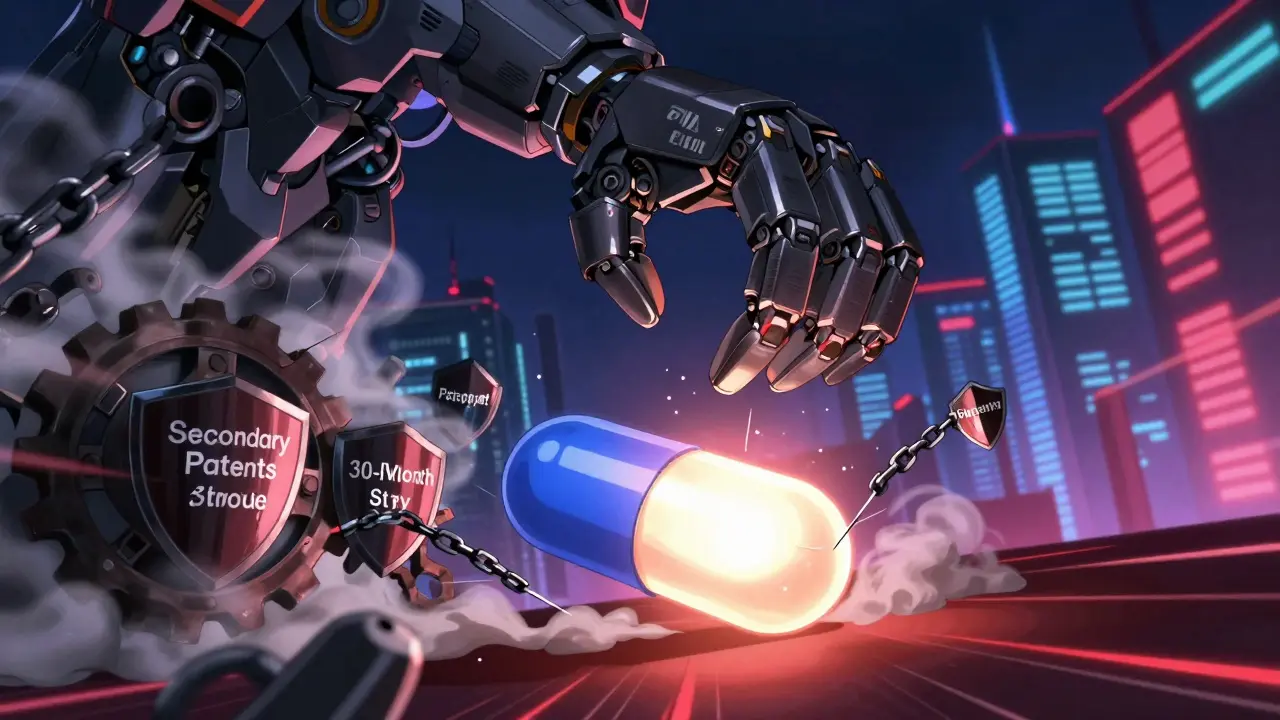
When a brand-name drug company gets FDA approval, it doesn’t mean the race for cheaper generics is over. In fact, the real battle often starts right then - and it can take years before patients see the lower-priced version on pharmacy shelves. The reason? The 30-month stay, a legal pause built into U.S. drug approval rules that lets patent holders delay generic entry by locking up regulatory approval while lawsuits play out.
What Exactly Is the 30-Month Stay?
The 30-month stay is part of the Hatch-Waxman Act, a 1984 law designed to balance two goals: letting generic drug makers enter the market faster, while still protecting the patents that made the original drug possible. Here’s how it works in practice.When a generic company wants to sell a copy of a brand drug, they file something called an Abbreviated New Drug Application (ANDA). If they believe the brand’s patents are invalid or won’t be infringed, they file what’s called a Paragraph IV certification. That’s a legal challenge. Once they do, they must notify the brand company and patent holders.
If the brand company sues for patent infringement within 45 days, the FDA is legally required to stop approving the generic for up to 30 months. That’s the stay. It doesn’t mean the FDA stops reviewing the application - they can and do give “tentative approval” during this time. But final approval? Locked until the clock runs out, the lawsuit ends, or a court says otherwise.
This isn’t a soft delay. It’s a hard stop. And it’s triggered every time a generic challenger files a Paragraph IV notice - unless the brand doesn’t sue. But in most cases, they do.
Why Does This Stay Exist?
Supporters say the 30-month stay is necessary. Without it, brand companies would have no real way to defend their patents before generics flood the market. Developing a new drug costs over $2 billion on average. If a generic could launch the day after approval, no company would risk that kind of investment.Former FDA Commissioner Scott Gottlieb points out that since 1984, over 12,000 generic drugs have been approved thanks to Hatch-Waxman. Consumers have saved about $2.2 trillion. The system works - but only if the patent system is respected.
But critics argue the stay has become a tool for delay, not protection. A 2021 study from USC and the University of Michigan found that the median time between the end of the 30-month stay and actual generic launch is 3.2 years. That’s not because of legal delays - it’s because companies are waiting for the right moment to launch. Meanwhile, the brand company has already been selling the drug for years, often at full price.
How Long Does the Delay Really Last?
The 30-month stay sounds like a fixed period. But in reality, it’s often just the beginning of the wait.For drugs with New Chemical Entity (NCE) status - meaning they’re truly new molecules - the FDA grants five years of regulatory exclusivity. That means even if the patent expires early, no generic can be approved for five years. When you add the 30-month stay on top, the total delay can stretch to nearly 40 months before a generic can even get tentative approval.
And that’s not the end. The FDA approved 782 generic drugs in 2022 - out of 1,046 ANDAs submitted. That means nearly a quarter were blocked by patents, exclusivity, or other legal barriers. Many of those were sitting in “tentative approval” limbo, waiting for litigation to end.
One key twist: the first generic company to file a successful Paragraph IV challenge gets 180 days of market exclusivity. That means other generics can’t launch until that 180-day window closes - even if the patent is already defeated. This creates a race. And it’s expensive. A 2022 survey of 45 generic manufacturers found that 63% spent $3-5 million per ANDA just on patent litigation.

How Do Brands Use This System to Extend Monopolies?
The real problem isn’t the 30-month stay itself - it’s how it’s used.Brand companies have learned to list dozens of patents in the FDA’s Orange Book - even ones that cover minor changes like a new pill shape, a slightly different dosage form, or a new manufacturing method. These are called “secondary patents.” A 2019 Brookings study found that 67% of patents listed for top-selling drugs were filed after the original drug got approved.
These patents don’t protect innovation - they protect profits. And each one can trigger a new 30-month stay. The 2003 Medicare Act tried to fix this by limiting brand companies to one 30-month stay per generic applicant. But loopholes remain. Some companies file lawsuits on different patents at different times, stretching out the delay.
According to the FTC, 78% of Paragraph IV lawsuits end in settlements - and nearly all of them include agreements that delay generic launch beyond patent expiration. These are called “pay-for-delay” deals. The brand pays the generic to stay off the market. The FTC estimates this adds $13.9 billion annually to U.S. drug costs.
How Do Generic Companies Respond?
Generic manufacturers don’t sit back and wait. They’ve built entire legal and regulatory teams just to navigate the Hatch-Waxman maze.Leading firms like Teva, Sandoz, and Sun Pharma now have dedicated Hatch-Waxman strategy teams. The average annual budget for these teams? $2.7 million per company. They hire lawyers who charge $1,250-$1,800 an hour. They track every patent in the Orange Book. They time their ANDA filings to hit the earliest possible window - often 4.1 years before the main patent expires.
And they’re getting smarter. When multiple generics challenge the same drug, approval comes faster. FDA data from 2022 shows drugs with multiple Paragraph IV filers reach the market 8.2 months sooner than those with just one challenger. That’s because competition forces quicker resolution - and sometimes, one company will settle early to get the 180-day exclusivity, letting others jump in right after.
What’s Different in Other Countries?
The U.S. system is unique. In the European Union, there’s no litigation-triggered delay. Generics can apply as soon as data exclusivity ends - and the brand can’t pause approval with a lawsuit. Canada has a 24-month stay, but it’s shorter and less flexible. Neither system has the 180-day exclusivity incentive that drives the U.S. race to be first.That’s why most ANDA submissions now come from Indian and Chinese manufacturers. They can afford to play the long game. In 2022, they accounted for 63% of all ANDA filings. U.S.-based companies are still major players, but they’re increasingly outgunned by lower-cost competitors who can absorb the legal risks.

Is the System Broken?
There’s no easy answer. The 30-month stay was never meant to be a tool for extending monopolies. It was meant to give patent holders time to resolve disputes - not to create a 5-year delay before generics even start.Dr. Aaron Kesselheim from Harvard says the stay now adds an average of 1.8 years to market exclusivity for blockbuster drugs. That’s not protection - that’s profit manipulation.
But change is coming. In 2023, Congress introduced the Affordable Prescriptions for Patients Act. It proposes cutting the stay from 30 months to 18 and banning stays for secondary patents. The FDA also released draft guidance pushing for more transparency in patent listings - meaning brand companies would have to prove each patent is truly relevant.
Industry analysts predict that if these reforms pass, $78 billion in branded drugs could face generic competition by 2028. That could save consumers $195 billion.
For now, the 30-month stay remains a powerful, complex, and controversial tool. It’s not the villain - but it’s being used like one.
What Happens After the Stay Ends?
Even when the 30-month clock runs out, the generic doesn’t hit shelves right away. The FDA issues final approval, but commercial readiness takes time.Manufacturers need to ramp up production, secure supply chains, negotiate with distributors, and train sales reps. The average gap between tentative approval and final launch is 11.3 months. That’s not because of the law - it’s because of logistics.
One Teva regulatory specialist noted on a pharmaceutical forum: “The 30-month stay gives brand companies false confidence. The real delay is on our end - getting the drug made, tested, and shipped.”
So the delay isn’t always legal. Sometimes, it’s just slow.
What’s Next?
The future of the 30-month stay is uncertain. With bipartisan support for reform and growing pressure to lower drug prices, changes are likely within the next five years. But even if the stay is shortened, the underlying tension remains: how do you reward innovation without blocking access?One thing is clear: patients aren’t waiting. And neither are the companies that want to sell them cheaper drugs.
What triggers the 30-month stay in generic drug approval?
The 30-month stay is triggered when a generic drug manufacturer files a Paragraph IV certification challenging a patent listed in the FDA’s Orange Book, and the brand-name drug company files a patent infringement lawsuit within 45 days of receiving notice. This automatically blocks the FDA from granting final approval for up to 30 months.
Does the FDA stop reviewing the generic application during the 30-month stay?
No. The FDA continues reviewing the generic application and can issue “tentative approval” during the stay. This means the drug meets all scientific and safety requirements - it just can’t be sold until the stay ends or the lawsuit is resolved.
Can a brand company trigger multiple 30-month stays for the same drug?
No. The 2003 Medicare Act limits brand companies to one 30-month stay per generic applicant. However, they can file lawsuits on different patents at different times, which can create sequential delays - though this is legally risky and increasingly scrutinized.
Why do some generics launch years after the 30-month stay ends?
The 30-month stay only removes the legal barrier. Commercial factors - like manufacturing scale-up, supply chain setup, pricing negotiations, and market timing - often cause further delays. The average gap between tentative approval and final launch is 11.3 months, and in some cases, it’s over three years.
What is the 180-day exclusivity period for generic drugs?
The first generic company to successfully challenge a patent with a Paragraph IV certification gets 180 days of market exclusivity. During that time, no other generic can launch - even if the patent is invalid. This incentive drives competition but can also delay broader access.
Are there efforts to change the 30-month stay system?
Yes. The Affordable Prescriptions for Patients Act of 2023 proposes reducing the stay to 18 months and banning it for secondary patents. The FTC and FDA are also pushing for more transparency in patent listings. Many experts believe major reforms are likely within the next five years.





Ryan Hutchison
January 17, 2026 AT 22:40The 30-month stay isn’t broken-it’s being weaponized by generic giants who treat patent law like a video game cheat code. We spend billions developing drugs, then some Indian pharma firm files a Paragraph IV just to game the system. The FDA gives tentative approval like it’s a free pass, but the real crime is letting foreign companies profit off American innovation while we pay the price. This isn’t competition-it’s economic espionage dressed up as healthcare reform.
Melodie Lesesne
January 19, 2026 AT 00:25I get where you're coming from, but honestly, I think the system just needs tweaking, not tearing down. My cousin works at a small generic lab in Ontario and they're drowning in paperwork just to file one ANDA. The 30-month stay feels like a necessary buffer-especially since lawsuits can drag on forever. Maybe shorten it to 18 months and crack down on shady patent listings? That way, patients get access faster without crushing the innovators.
Corey Sawchuk
January 19, 2026 AT 06:00the 30 month thing is wild when you think about it
brand companies just keep adding patents like they're collecting baseball cards
one for the color of the pill
one for the packaging
one for how you hold it
and suddenly you've got 17 stays stacked up
and no one even remembers what the original drug was for
evelyn wellding
January 19, 2026 AT 15:05OMG this is so important!! 💪 Patients are suffering while big pharma plays chess with our health care 😤 I had to pay $800 for a 30-day supply of my meds last year-my friend got the generic for $12 after the stay ended. We need change NOW!! 🙏 #LowerDrugPrices #HatchWaxmanNeedsFixing
Corey Chrisinger
January 20, 2026 AT 02:40It’s funny how we treat patents like sacred texts when they’re really just legal tools. The 30-month stay was designed to protect innovation, not to create a 5-year monopoly by committee. But here’s the real question: if a patent covers a pill shape, is that innovation-or just a tax on consumers? We’ve turned medicine into a courtroom sport, and the players aren’t doctors-they’re lawyers with six-figure billing rates. Maybe the real problem isn’t the stay… it’s that we’ve forgotten what medicine is supposed to be for.
Bianca Leonhardt
January 20, 2026 AT 11:01Anyone who thinks this system is fair is either paid by Big Pharma or lives under a rock. The 180-day exclusivity loophole? That’s not incentive-that’s a cartel. And the pay-for-delay settlements? That’s bribery with a white coat. You call it ‘balancing innovation and access’-I call it theft with a FDA stamp. Stop pretending this is about science. It’s about greed. And it’s killing people who can’t afford their insulin.
swarnima singh
January 20, 2026 AT 11:47u know what... this whole system is so messed up... like why should one company get to own a molecule for 20 years? its like saying u own air if u discover oxygen... the real heroes are the lab techs in india and china who actually make the drugs... not the suits in new jersey who just file patents for the color of the pill... and then wonder why people hate them... #patentsarenotmorals
Isabella Reid
January 20, 2026 AT 18:00Canada’s 24-month stay is way more reasonable. We don’t have the 180-day exclusivity mess, and generics still come out fast enough. The U.S. system feels like it was designed by lobbyists who never met a patient. I get that R&D is expensive-but if the only way to protect profit is to lock out affordable meds for years, then maybe we need to rethink who the system is really serving. Change is coming. I just hope it gets here before someone I love can’t afford their meds again.