
What Exactly Are Cataracts?
Cataracts are a natural part of aging for most people. They happen when the clear lens inside your eye slowly becomes cloudy, like a frosted window. This clouding blocks light from reaching the retina, making everything look blurry, faded, or washed out. You might notice glare from headlights at night, colors seem duller, or you need brighter light just to read a book. It’s not a film over the eye - it’s the lens itself changing. About 24.4 million Americans aged 40 and older have cataracts, and the numbers rise sharply after age 60. In the UK, nearly everyone over 75 shows some signs of lens clouding, even if it hasn’t affected vision yet.
Why Does the Lens Cloud Up?
The lens is made mostly of water and protein. Over time, these proteins start to clump together, scattering light instead of focusing it. This isn’t caused by reading too much, using screens, or squinting in the sun. It’s biological aging - the same way skin wrinkles or hair turns gray. But certain things can speed it up: long-term diabetes, smoking, prolonged steroid use, or severe eye injuries. UV exposure doesn’t directly cause cataracts, but it may contribute to long-term damage. The good news? Cataracts aren’t contagious, they don’t spread from eye to eye, and they don’t cause pain.
How Is Cataract Surgery Done Today?
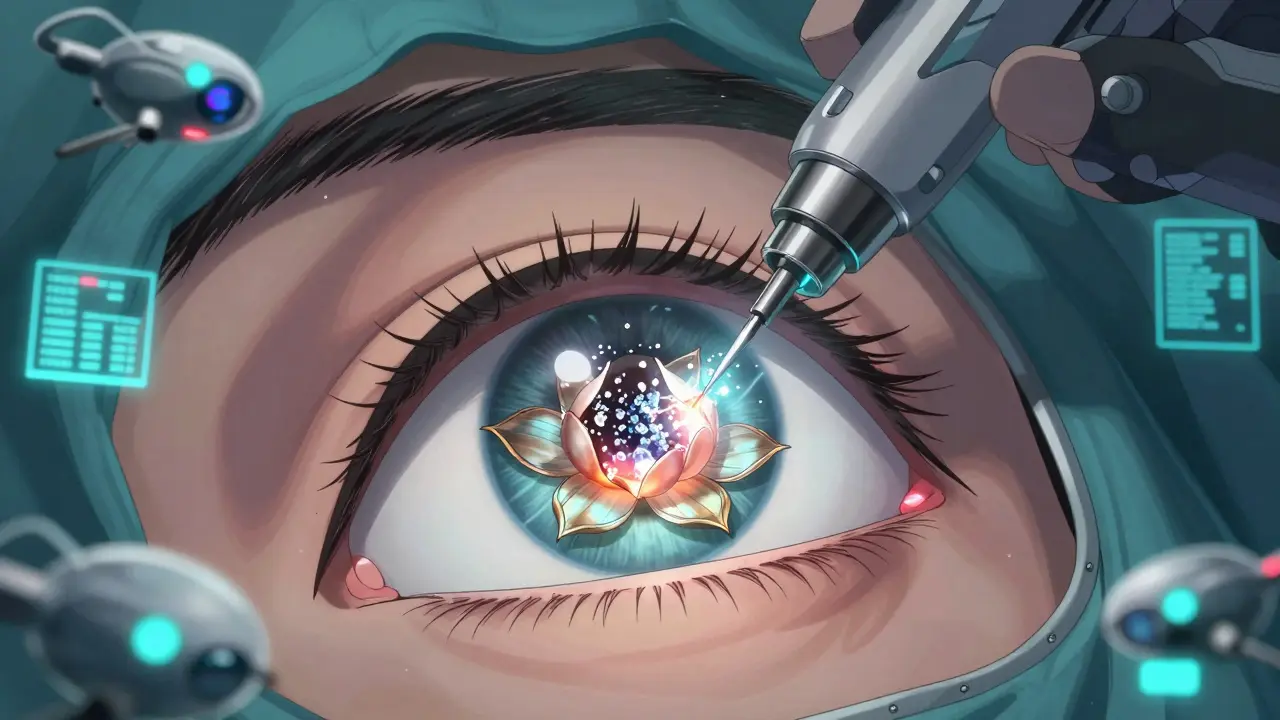
Modern cataract surgery is nothing like the old "couching" method, where the cloudy lens was just pushed deeper into the eye. Today, over 95% of procedures use a technique called phacoemulsification. A tiny ultrasound probe is inserted through a 2.2-2.8mm incision in the cornea. It breaks the cloudy lens into small pieces, then gently suctions them out. The lens capsule - the natural pocket that held the lens - stays intact. Then, a foldable intraocular lens (IOL) is inserted and unfolds inside that same capsule. The whole thing takes 15-20 minutes, is done under local anesthetic drops, and you go home the same day. No stitches are needed because the incision is so small it seals on its own.
What Kind of Lens Is Implanted?
The IOL you get determines how much you’ll need glasses after surgery. There are three main types:
- Monofocal IOLs - These correct vision for one distance, usually far. You’ll likely still need reading glasses for close work. They’re the most common and covered by most insurance plans.
- Toric IOLs - These correct astigmatism in addition to cataracts. If you had astigmatism before, this can reduce your dependence on glasses for distance.
- Premium multifocal or trifocal IOLs - These offer clear vision at near, intermediate, and far distances. Brands like Alcon’s PanOptix and Johnson & Johnson’s Tecnis Symfony have shown 80-90% of patients don’t need glasses for daily tasks. But they cost extra - between $2,500 and $4,500 per eye out-of-pocket.
Medicare and most insurers cover the cost of basic monofocal lenses and the surgery itself. Premium lenses are considered elective upgrades, so you pay the difference. The choice depends on your lifestyle. A retiree who reads a lot might prefer a multifocal. Someone who drives mostly and doesn’t mind reading glasses might stick with monofocal.
What to Expect After Surgery
Right after surgery, your vision will be blurry. That’s normal. Your eye needs time to adjust. You might feel scratchiness, stickiness, or mild discomfort for a day or two. Vision typically improves within 1 to 3 days, but full healing takes longer. Most people report 90% of their visual acuity is restored within weeks. Colors look brighter - many patients say it’s like watching TV in HD for the first time in decades. But your brain needs to relearn depth perception. One patient on Reddit said, "My brain had to relearn how far things were." That’s common.
Recovery Rules: What You Can and Can’t Do
Doctors are consistent on recovery guidelines:
- Don’t drive until your surgeon clears you - usually within a few days.
- Avoid heavy lifting, bending over, or strenuous exercise for at least two weeks.
- Keep water, soap, and shampoo out of your eye for the first week.
- Wear the protective shield at night for the first few nights.
- Use prescribed eye drops: antibiotics (like Vigamox) four times a day for a week, and steroid drops (like Pred Forte) tapered over four weeks.
Some clinics say you can start simple eye exercises - like shifting focus between a book and a distant object - as early as 24 hours after surgery. These help your eye adapt to the new lens. Vision therapy, if recommended, can improve focus, reduce eye strain, and even help with memory and concentration after surgery.
Will You Still Need Glasses?
It depends on the lens you choose. With a standard monofocal IOL, you’ll almost certainly need reading glasses. Even with toric lenses, you might need glasses for fine print. Premium multifocal lenses reduce this need dramatically - up to 89% of users report no glasses for daily tasks. But no lens is perfect. Some people notice halos around lights at night, especially with multifocals. That usually fades over time. If your vision doesn’t improve as expected, it could be due to other conditions like glaucoma, macular degeneration, or diabetes. These don’t prevent surgery, but they can limit how much vision you regain.
What Are the Risks?
Cataract surgery is one of the safest procedures in medicine. Over 3.8 million are done in the U.S. every year, with a 98% patient satisfaction rate. Serious complications happen in only 2-5% of cases. The most common issue is posterior capsule opacification - sometimes called a "secondary cataract." It’s not a new cataract. It’s just a thin film that grows on the back of the lens capsule, causing blur to return. It’s easily fixed with a quick, painless laser treatment called YAG capsulotomy, which takes five minutes and requires no recovery time. About 20-30% of patients need this within five years.
How Long Does Recovery Really Take?
There’s no single answer. Cleveland Clinic says four weeks. MyHealth Alberta says three to ten weeks. West Boca Eye Center says six to eight. The truth? Most people feel like their vision is back to normal within a month. But full healing - where your eye stabilizes and your brain fully adapts - can take up to three months. If you’re still noticing glare, halos, or blurriness after eight weeks, talk to your surgeon. It might be a residual refractive error that can be corrected with glasses or a laser touch-up.

What’s New in Cataract Technology?
The field is advancing fast. In January 2023, the FDA approved Zeiss’s AT LISA tri 839MP IOL, designed for better intermediate vision - perfect for computer screens and dashboards. New accommodating IOLs, which mimic the natural movement of a young lens by shifting focus, are in Phase III trials. These could one day eliminate the need for glasses entirely. The global market for cataract devices is projected to hit $6.32 billion by 2027, driven by aging populations and better lens designs. The goal isn’t just to restore vision - it’s to restore quality of life.
When Should You Consider Surgery?
You don’t need surgery just because you have a cataract. You need it when it interferes with your life. Can you no longer read the newspaper? Struggle to recognize faces? Feel unsafe driving at night? If your vision is affecting your independence, safety, or joy, it’s time to talk to an ophthalmologist. Waiting won’t make it worse - but it will make your life harder. Surgery isn’t a race. But when the time comes, it’s one of the most life-changing decisions you’ll make.
Can Cataracts Come Back?
No. Once the cloudy lens is removed, it can’t grow back. But as mentioned, the capsule holding the new lens can cloud over. That’s not a cataract - it’s a side effect of healing. And it’s easily fixed. The IOL itself lasts a lifetime. You won’t need another lens replacement.
Can cataracts be prevented?
There’s no proven way to prevent cataracts entirely, since they’re tied to aging. But you can slow them down. Wear UV-blocking sunglasses, don’t smoke, manage diabetes if you have it, and eat a diet rich in antioxidants - leafy greens, carrots, nuts, and berries. These won’t stop cataracts, but they support overall eye health.
Is cataract surgery painful?
No. You’ll get numbing drops, and you might feel pressure, but not pain. Most people say it’s less uncomfortable than a dental cleaning. After surgery, mild scratchiness or itching is normal for a day or two. Over-the-counter pain relievers like paracetamol are usually enough.
How long does it take to see clearly after surgery?
Most people notice improved vision within 1 to 3 days. But full clarity can take weeks as your eye heals and your brain adjusts. If you’re still blurry after a month, check in with your surgeon.
Are there alternatives to surgery?
No. Glasses or brighter lighting can help temporarily, but they don’t fix the clouded lens. Surgery is the only way to restore clear vision. Delaying it won’t harm your eye, but it will keep you from seeing well.
Can I have surgery on both eyes at once?
Usually not. Surgeons operate on one eye at a time, with a few weeks between procedures. This lets the first eye heal and gives you time to adjust before the second. It also reduces risk.
Will I need to wear glasses after surgery?
It depends on the lens. With a standard monofocal IOL, you’ll likely need reading glasses. With premium multifocal or toric lenses, many people don’t need glasses for daily tasks. But no lens is perfect - some may still need glasses for fine print or night driving.
How do I know if I’m a good candidate?
If cataracts are affecting your daily life - driving, reading, recognizing faces, or enjoying hobbies - you’re likely a good candidate. Your ophthalmologist will check for other eye conditions like glaucoma or macular degeneration, which can affect outcomes. But cataract surgery is safe even for people with these conditions.
Final Thoughts
Cataracts don’t have to mean losing your independence. With modern surgery, vision can be restored to nearly its former clarity - often better than you remember. The procedure is quick, safe, and life-changing. The biggest mistake people make is waiting too long. If your vision is fading, don’t wait for it to get worse. Talk to an eye specialist. You might be surprised how much you’ve been missing.




Joy Nickles
December 31, 2025 AT 19:52Emma Hooper
January 1, 2026 AT 04:55Martin Viau
January 1, 2026 AT 06:00Robb Rice
January 2, 2026 AT 21:29Retha Dungga
January 3, 2026 AT 03:07Aaron Bales
January 5, 2026 AT 01:20Urvi Patel
January 5, 2026 AT 06:50anggit marga
January 7, 2026 AT 04:46Marilyn Ferrera
January 9, 2026 AT 04:18Harriet Hollingsworth
January 9, 2026 AT 16:31Deepika D
January 10, 2026 AT 15:22Bennett Ryynanen
January 12, 2026 AT 10:54Chandreson Chandreas
January 14, 2026 AT 07:25Darren Pearson
January 14, 2026 AT 07:26