
Every time you pick up a refill, your pills might look different. Same medicine. Different color. Different shape. Maybe even a different brand name on the bottle. It’s normal-but it’s also where mistakes happen.
One in five people over 65 say they’ve been confused when their pills changed appearance. And it’s not just seniors. Anyone taking regular medication-especially for high-blood pressure, thyroid issues, or seizures-needs to check every label. A mismatched dose, a wrong generic, or a double dose from mixing brands can land you in the hospital. You don’t need to be a pharmacist to catch these errors. You just need to know what to look for.
What to Check First: Your Name and Prescription Number
Start with the basics. Look at the top of the label. Is your full name spelled right? Not just your first name. Not "E. Markham"-it should be "Evelyn Markham." Even a small typo can mean someone else’s medication ends up in your bottle. This happens more often than you think, especially in busy pharmacies.
Next, find the Rx#. That’s your prescription number. It’s unique to you and this specific order. If the number is different from your last refill, that’s fine-it should be. But if it’s the same number as last time, that’s a red flag. It could mean the pharmacy didn’t process a new fill. Always write it down or take a photo. You’ll need it if you call to ask questions later.
Match the Medication Name: Brand vs. Generic
Look for two names: the brand name (like "Lipitor") and the generic name (like "atorvastatin"). The generic name is what matters most. It’s the active ingredient-the part that actually works in your body.
Let’s say your old label said "Lipitor 20mg." Your new label says "Atorvastatin 20mg." That’s normal. Generic drugs are cheaper versions of brand-name drugs. The FDA requires them to have the same active ingredient, strength, and effect. But here’s the catch: the brand name might disappear entirely. If your old bottle said "Lipitor" and the new one says only "Atorvastatin," that’s fine. Just make sure the generic name hasn’t changed.
If you see two different generic names-for example, "atorvastatin" one time and "rosuvastatin" the next-that’s not okay. Those are different drugs. Call the pharmacy immediately.
Dosage Strength: Don’t Assume It’s the Same
The strength is the number after the drug name. It tells you how much of the drug is in each pill. "10mg," "5mg," "25mcg"-these numbers are critical.
Some people assume if the pill looks similar, the dose is the same. It’s not. A 10mg pill might be blue and oval. A 20mg pill might be white and round. But if the label says "10mg" on both, you’re safe. The problem comes when the label says "10mg" but the pill looks like the 20mg version you took last month. That’s a mismatch.
Check the strength against your last bottle. If it’s different, ask: "Did my doctor change my dose?" If they didn’t, the pharmacy made a mistake. Don’t take it. Return it.
Manufacturer and Appearance: Why Your Pills Look Different
Generic drug makers aren’t allowed to copy the exact look of brand-name pills. So one company makes your atorvastatin as a white oval with "ATV 10" stamped on it. Another makes it as a blue capsule with "10" printed on the side. Both are correct. Both are safe. But they look nothing alike.
That’s why you can’t rely on how the pill looks. You need to rely on the label. But here’s where things get tricky: for some medications, even small differences between generic manufacturers can matter. Blood thinners like warfarin, anti-seizure drugs like phenytoin, and thyroid meds like levothyroxine are in this group. Small changes in how the drug is absorbed can throw off your levels.
If you take one of these drugs, ask your pharmacist: "Can I stay on the same manufacturer?" Some pharmacies let you request a specific generic brand. If you’ve been stable on one, ask them to stick with it. If you can’t, keep a photo of your pill next to the bottle. That way, if the next refill looks different again, you’ll know whether it’s normal or not.

Check the Date, Refills, and Prescriber
Look at the date the prescription was filled. Is it recent? If it’s from last year, the pharmacy might have pulled an old record. That’s rare, but it happens.
Check how many refills are left. If your last bottle had two refills left and this one says zero, your doctor may have stopped the prescription. Confirm with them before refilling again.
Finally, make sure the prescriber’s name matches. If your last refill came from Dr. Patel and this one says Dr. Lee, that’s a warning. Did you switch doctors? If not, the pharmacy might have mixed up your file.
Use the Pill Identifier Tool
If you’re unsure about a pill’s identity, don’t guess. Use the FDA’s free Pill Identifier tool on Drugs.com. It’s simple: pick the pill’s shape, color, and imprint (the letters or numbers stamped on it). The tool shows you a picture and name of the matching drug.
For example: if you see a small white tablet with "10" on one side and "ATV" on the other, enter those details. The tool will confirm it’s atorvastatin 10mg. If it says it’s something else-like amoxicillin-you’ve caught a serious error before taking it.
Many people use this tool after a refill. It takes less than a minute. And it’s saved lives.
Red Flags: When to Stop and Call
Here’s what you should never ignore:
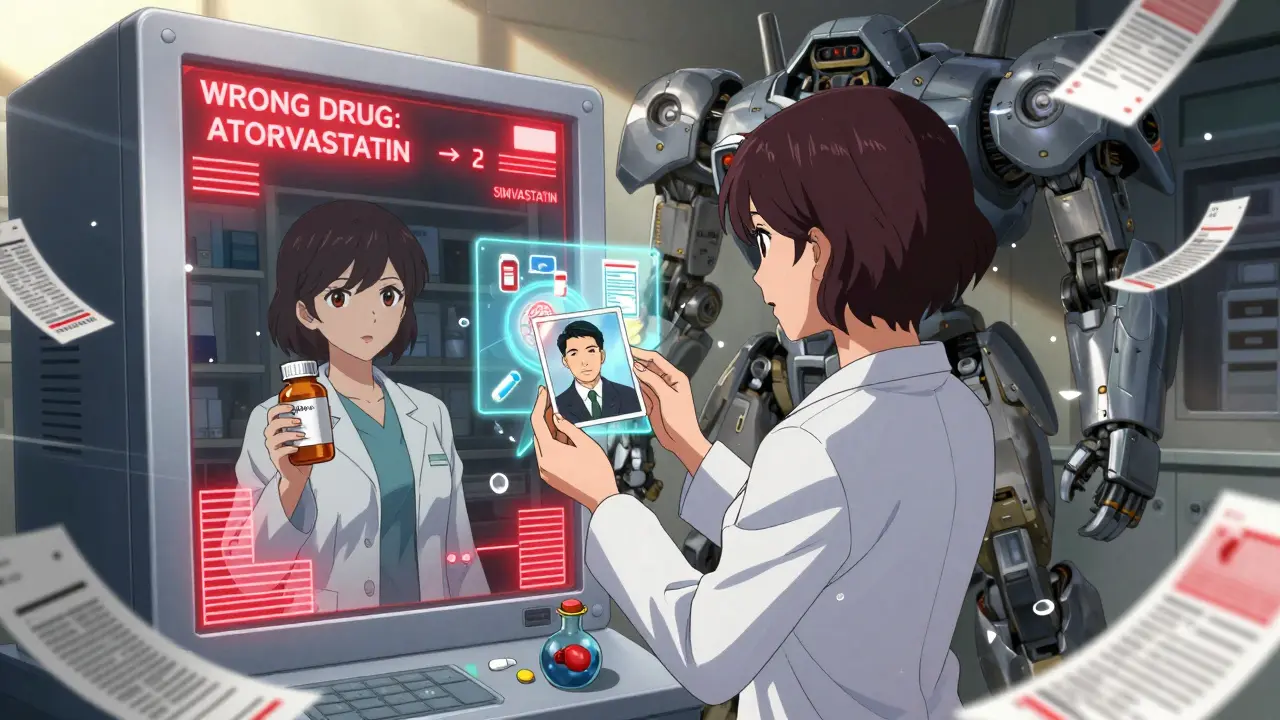
- The active ingredient changed (e.g., from atorvastatin to simvastatin)
- The dosage strength is wrong (e.g., 10mg instead of 5mg)
- The label says "Brand Substitution Not Permitted" but you got a generic
- The pill looks completely different and you can’t identify it with the tool
- The expiration date is more than a year away-this could mean it’s an old stock refill
If any of these happen, call the pharmacy right away. Don’t wait. Don’t take the pills. Ask them to recheck the order. If they dismiss you, call your doctor. Your safety is more important than their schedule.
How to Stay Organized
Keep a simple system:
- Take a photo of each new bottle-label and pill-when you get it.
- Write down the Rx#, strength, manufacturer, and date on a notepad or phone note.
- Keep old labels in a folder until you’ve finished the bottle.
- When you get a refill, compare the new label to the photo and notes side by side.
One woman in Bristol told me she started doing this after her husband accidentally took his blood pressure pills instead of his diabetes pills. They looked similar. He ended up in the ER. Now she takes a photo of every bottle. She says it’s the only thing that gives her peace of mind.
Why This Matters More Than Ever
Ninety percent of prescriptions in the U.S. are filled with generics. That’s up from 50% in 2005. The cost savings are real-but the risk of confusion is too. Pharmacies switch manufacturers to save money. You don’t always know when it happens.
Electronic prescriptions have cut down on handwriting errors. But they don’t stop generic switches. That’s still up to the pharmacy’s system. And if you don’t check, you won’t know.
Medication errors are one of the leading causes of preventable harm in healthcare. Most happen because someone didn’t compare the label. You can be the one to stop it.
It takes five minutes. A photo. A quick check. A call if something’s off. That’s all it takes to stay safe.
Why do my pills look different every time I refill my prescription?
Generic drug manufacturers aren’t allowed to copy the exact color, shape, or size of brand-name pills. So even if the active ingredient is the same, the pill can look completely different depending on which company made it. This is normal and legal under FDA rules. But you should still check the label to confirm the drug name and strength haven’t changed.
Can I trust the generic version of my medication?
Yes-for most medications, generics are just as safe and effective as brand names. The FDA requires them to have the same active ingredient, strength, dosage form, and how they work in your body. But for certain drugs like blood thinners, thyroid meds, and seizure medications, even tiny differences in how the body absorbs the drug can matter. If you take one of these, ask your pharmacist if you can stick with the same manufacturer.
What should I do if my new prescription label has a different drug name?
If the generic name is different-like switching from atorvastatin to simvastatin-that means you’ve been given a completely different medication. This is a serious error. Don’t take it. Call the pharmacy immediately and ask them to confirm your prescription with your doctor. You may need a new prescription.
Is it safe to mix pills from different bottles in one container?
No. Mixing pills from different prescriptions into one pill organizer increases the risk of taking the wrong dose or wrong drug, especially if the pills look similar. Always keep medications in their original bottles with the labels intact. If you need a pill organizer, use one with separate compartments and label each section clearly with the drug name and time of day.
What if the pharmacy refuses to let me know which manufacturer made my pills?
You have the right to know. The manufacturer name is printed on the label, usually under "Mfg:" or "Manufactured by." If it’s not clear, ask the pharmacist to show you the label or print a copy. If they refuse, ask to speak to the pharmacy manager. Your safety depends on knowing what’s in your bottle.
Next Steps: Make This a Habit
Don’t wait until something goes wrong. Make checking your prescription label part of your routine. When you get a refill, pause for two minutes. Compare the new label to the old one. Take a photo. Write down the key details. Use the pill identifier if you’re unsure.
It’s not about being paranoid. It’s about being in control. You’re the one taking the medicine. You’re the one who knows your body best. No one else will check for you. But you can.





Connor Hale
January 3, 2026 AT 17:30It's wild how much we trust pharmacies without question. I used to just grab my pills and go until my grandma ended up with someone else's blood thinner. Now I check every label like it's a bomb defusal manual. Five minutes could save your life.
Roshan Aryal
January 4, 2026 AT 09:53This is why America's healthcare system is a joke. Generic drugs? More like generic chaos. You're lucky if you don't get a placebo wrapped in a Walmart bag. The FDA doesn't care about your thyroid levels as long as the profit margin stays high.
Uzoamaka Nwankpa
January 6, 2026 AT 03:53I remember when my pills changed color and I cried for an hour. I thought I was dying. No one told me it was normal. I felt so alone. Now I take pictures but it still makes my chest tight every time I open the bottle.
Jennifer Glass
January 6, 2026 AT 16:44I started keeping a little notebook next to my pill organizer. Brand name, generic, strength, manufacturer, date. It’s not glamorous, but it’s the only thing that gives me a sense of control. I wish more people knew how simple this is to do.
Joseph Snow
January 7, 2026 AT 08:28Let’s be honest: this entire system is designed to confuse you. Pharmacies switch manufacturers to cut costs, and then they expect you to be a pharmacologist. Meanwhile, your doctor is rushing through appointments. This isn’t safety-it’s negligence wrapped in a brochure.
en Max
January 7, 2026 AT 14:29It is imperative to emphasize, with the utmost gravity, that medication reconciliation-particularly in polypharmacy cohorts-is not merely a best practice, but a non-negotiable component of patient-centered care. The absence of label verification constitutes a critical failure in the medication administration lifecycle.
Angie Rehe
January 8, 2026 AT 19:50Why don’t pharmacies just print the manufacturer on the front? Why do they hide it like it’s a secret? I asked my pharmacist and she acted like I was accusing her of something. This isn’t about being paranoid-it’s about demanding transparency.
Enrique González
January 10, 2026 AT 08:32Do this one thing today: take a photo of your next pill bottle. Just one. Do it before you open it. You’ll thank yourself next month when the color changes.
Aaron Mercado
January 11, 2026 AT 20:45THEY’RE LYING TO YOU!! The FDA doesn’t require generics to be identical-just "bioequivalent"-which means your body might absorb it differently!! I read a study from 2019 that showed 1 in 4 people on levothyroxine had dangerous fluctuations because of manufacturer switches!! THEY DON’T WANT YOU TO KNOW THIS!!
John Wilmerding
January 12, 2026 AT 15:51One of the most effective tools I’ve seen patients use is maintaining a medication log-digital or paper-that includes the prescription number, active ingredient, dosage, manufacturer, and date received. This allows for rapid comparison and reduces cognitive load during refill checks. Highly recommended.
Shanna Sung
January 14, 2026 AT 15:22They’re putting tracking chips in the pills now. I saw it on a video. The label says one thing but the pill is coded. They’re monitoring your meds. Don’t take it unless you want them to know when you skip a dose.
Allen Ye
January 15, 2026 AT 22:00There’s a deeper philosophical question here: if a pill looks different but does the same thing, is it still the same medicine? Or are we just accepting a manufactured illusion of consistency? The pharmaceutical industry profits from our inability to distinguish between form and function-and we’ve trained ourselves to trust the label over our own senses.
mark etang
January 17, 2026 AT 07:09Every time I refill my meds, I say a quiet thank you to the person who wrote this guide. This isn’t just advice-it’s a lifeline. Thank you for making it clear, calm, and actionable.
John Ross
January 18, 2026 AT 01:47Let’s not ignore the systemic issue: the shift from brand to generic is driven by PBM reimbursement structures, not clinical outcomes. Pharmacies are incentivized to switch manufacturers based on rebate tiers, not patient stability. This is a supply chain problem disguised as a patient education issue.
Connor Hale
January 18, 2026 AT 17:11That’s why I keep the old bottles for 30 days. I don’t throw them out until I’m sure the new one’s right. I don’t trust my memory. I trust the plastic.