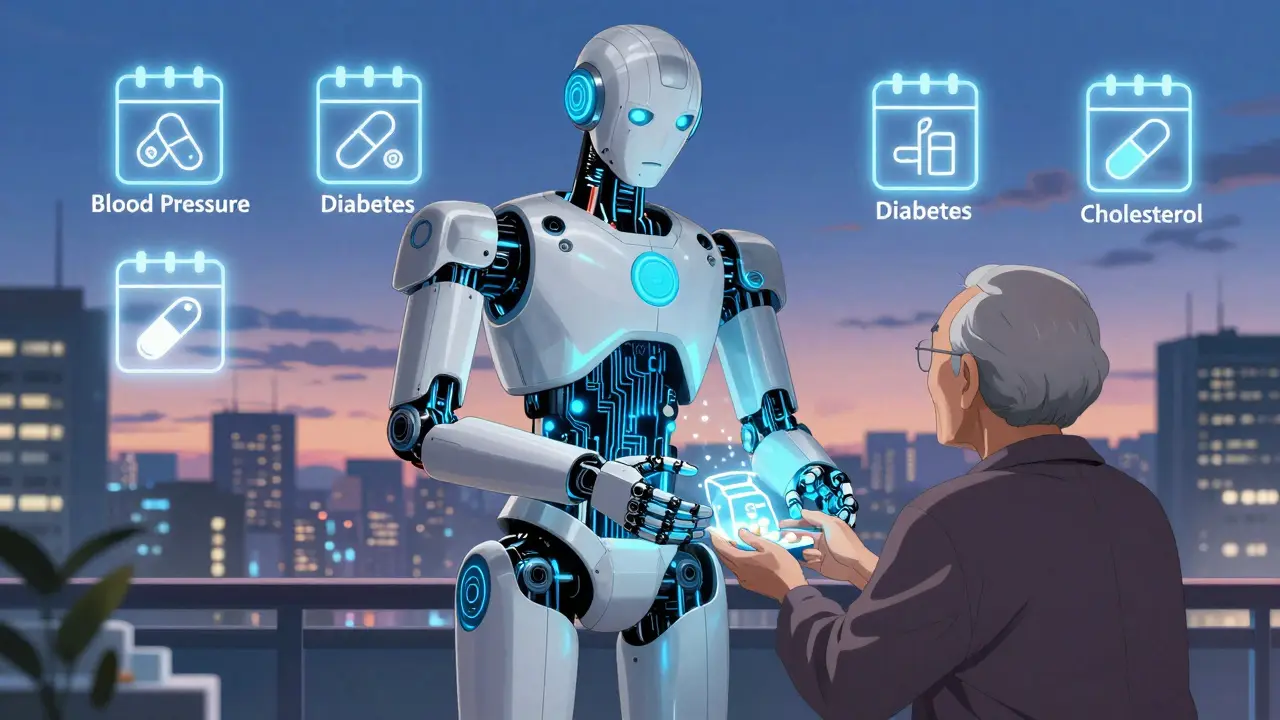
Managing multiple medications every week can feel overwhelming. You’re taking pills for high blood pressure, diabetes, cholesterol, and maybe even depression. Some need to be taken daily, others weekly. You forget which day you last refilled one. You run out mid-month. You miss a dose. And before you know it, your health starts slipping. This isn’t just inconvenience-it’s dangerous. About half of all people with chronic conditions don’t take their medications as prescribed. That’s not because they don’t care. It’s because the system is broken.
What Is Refill Synchronization?
Refill synchronization-also called med sync-is a simple pharmacy service that lines up all your regular medications to refill on the same day each month. Instead of juggling different refill dates-some every 30 days, others every 60 or 90-you get them all ready at once. Your next refill date becomes a single day: the 15th, the 1st, or whatever works best for you. You pick them up once a month, or get them delivered. No more surprise out-of-stock moments. No more guessing.
This isn’t new. Pharmacies started experimenting with it around 2010. By 2014, over 350,000 patients in the U.S. were already using it. Today, more than 12 million people rely on it. And the numbers keep climbing. Why? Because it works. Studies show patients who use med sync improve their adherence by 3 to 8 percentage points. That might sound small, but for someone with heart disease or diabetes, it can mean the difference between staying out of the hospital and ending up in one.
How It Actually Works
It’s not magic. It’s a four-step process, handled by your pharmacist.
- Initial review: Your pharmacist sits down with you-either in person or over the phone-and looks at every medication you’re taking. They check what you’re supposed to take, how often, and when your last refill was. They don’t just look at the prescription label. They look at your history.
- Adjusting quantities: Here’s where the magic happens. If your blood pressure pill runs out on the 5th and your cholesterol pill runs out on the 20th, your pharmacist might give you an extra week’s supply of the blood pressure pill so both align to the 20th. They’re not giving you more pills than you need. They’re just shifting the timing so everything syncs up.
- Monthly refill day: Now, every month, on the same date, all your medications are ready. You walk in, pick them up, and leave. No calls. No confusion. No panic if you forgot to refill one.
- Monthly check-in: Your pharmacist doesn’t just hand you the pills and forget you. They check in each month. Did you start a new medication? Did your dose change? Are you having side effects? This ongoing contact is part of why med sync works so well.
This isn’t just about convenience. It’s about reducing decision fatigue. When you’re managing a chronic illness, every choice drains your energy. Med sync removes one of the biggest mental burdens: tracking refills.
Who Benefits the Most?
Not everyone needs this. But if you take three or more maintenance medications for conditions like:
- Hypertension
- Diabetes
- High cholesterol
- Thyroid disease
- Depression or anxiety
- Arthritis or osteoporosis
-then med sync is designed for you. Studies show the biggest improvements happen in patients with low baseline adherence. That means if you’ve been missing doses, this could be the game-changer.
People on Medicare Advantage plans see especially strong results. In one study, those who used med sync and filled all their prescriptions at retail pharmacies improved their adherence by up to 11 percentage points. That’s huge. For someone with diabetes, that could mean better blood sugar control. For someone with heart disease, it could mean fewer heart attacks.
It doesn’t work as well for acute medications-like antibiotics or painkillers taken only for short periods. But for long-term, daily drugs? It’s one of the most effective tools we have.

Real Results, Real Stories
Take Sarah, 72, from Bristol. She was on five medications: one for blood pressure, two for diabetes, one for cholesterol, and one for osteoporosis. She’d miss doses because she’d run out at different times. Her last PDC (proportion of days covered) score-the clinical measure of adherence-was 65%. That’s below the 80% threshold doctors consider safe.
After enrolling in med sync, her pharmacist adjusted her refills to the 10th of every month. She got a reminder text. She picked them up on her way to the grocery store. Within three months, her PDC jumped to 92%. Her blood pressure dropped. Her A1C improved. Her doctor said, “You’re doing better than most patients half your age.”
On Reddit, u/MedicationMama wrote: “Since my pharmacist synced my 5 medications to the 15th of each month, I haven’t missed a single dose in 18 months-this has literally changed my diabetes management.”
These aren’t outliers. A 2019 Pharmacy Times survey found 68% of med sync users reported they never ran out of medication. Only 42% of non-users could say the same.
Why It Works Better Than Mail Order
You might think, “Why not just use mail order? I get everything delivered.” But mail order doesn’t fix the problem-it just moves it. You still get refills on different dates. You still have to remember when each one is due. And if you miss a delivery window? You’re out of pills for days.
Med sync is different. It’s tied to your local pharmacy. That means:
- You can talk to someone face-to-face if you have questions.
- You can get same-day replacements if you lose a pill.
- Your pharmacist knows your history and can spot drug interactions.
- You get monthly check-ins-not just a box in the mail.
Studies show the adherence boost from med sync is three to four times higher for people using retail pharmacies compared to mail order. Why? Because human contact matters. The pharmacist remembers your name. They notice if you haven’t picked up in a while. They call you. That’s what makes the difference.
What’s Holding People Back?
It’s not that med sync doesn’t work. It’s that not everyone knows about it-or can get it.
One big barrier? Insurance. Some plans don’t allow early refills. If your pill runs out on the 5th, but your sync date is the 15th, your insurer might refuse to cover it until the 15th. That’s a problem. But good pharmacists know how to work around it. They’ll:
- Call your doctor for a one-time early refill authorization.
- Adjust your initial supply so you never run out.
- Use a 90-day supply with staggered start dates to smooth the transition.
Another issue? Patient confusion. “Why are you giving me more pills now?” patients ask. It takes time to explain. Pharmacists say it takes 20 to 30 minutes for the first enrollment. But once it’s set, it’s effortless.
And yes, some pharmacies still don’t offer it. But as of 2022, 87% of chain pharmacies and 45% of independent pharmacies in the U.S. now do. If your pharmacy doesn’t, ask. Demand matters.

What’s Next?
Med sync is evolving. CVS Health now links it to their app, sending automated refill reminders. Walgreens added a “Sync & Save” program that cuts copays for synced medications. Kroger Health is testing virtual pharmacist check-ins right after your monthly pickup.
By 2025, the American Pharmacists Association predicts 75% of U.S. pharmacies will offer formal med sync programs. Why? Because value-based care is here. Insurance companies and Medicare now pay pharmacies based on how well patients adhere to their meds-not just how many prescriptions they fill.
And the numbers tell the story: a 1 percentage point improvement in adherence for cardiovascular drugs saves Medicare $206 million a year. That’s not just good for patients. It’s good for the system.
How to Get Started
If you take three or more regular medications, here’s how to get med sync:
- Ask your pharmacist: Don’t wait for them to bring it up. Say: “Can you help me sync all my refills to one day?”
- Bring your list: Bring all your pill bottles or a written list of medications, including dosages and how often you take them.
- Be ready to adjust: You might get an extra week’s supply at first. That’s normal. It’s how they align the dates.
- Confirm your date: Make sure you know the new refill day. Set a calendar alert.
- Stay in touch: Go back each month. Even if you don’t need refills, check in. That’s how they catch problems early.
It’s not complicated. It’s not expensive. It doesn’t require new technology. Just a conversation with your pharmacist-and a willingness to let them help you simplify.
Final Thought
Medication adherence isn’t about willpower. It’s about design. If the system makes it hard to take your pills, you won’t take them. Med sync doesn’t ask you to be perfect. It just makes it easier. And in healthcare, sometimes that’s all it takes.



Robert Petersen
February 9, 2026 AT 13:43Love this breakdown. I’ve been syncing my meds for two years now and it’s been a game-changer. No more frantic calls to the pharmacy at 11 p.m. because I ran out. No more wondering if I took my pill yesterday. It’s just… smooth. My pharmacist even remembers my dog’s name now. That’s the kind of care you can’t get from mail-order.
Alyssa Williams
February 11, 2026 AT 08:42This is literally the best thing that’s happened to my health in years. I used to forget half my pills. Now I pick them up with my coffee. Life’s too short to stress over pill schedules. Pharmacies should push this harder.
Craig Staszak
February 12, 2026 AT 13:15Simple solution to a massive problem. Why isn’t this standard everywhere? My grandma’s on six meds. She used to mix up the bottles. Now she just walks in once a month. Done. No thinking required. That’s healthcare done right.
Ojus Save
February 12, 2026 AT 23:45cool idea but i think its just another way for pharmacies to make money
Ernie Simsek
February 14, 2026 AT 07:05OMG YES. I’ve been doing this for 8 months and my A1C dropped 2 points. Also my pharmacist gave me a free bag of gummy vitamins last month. She’s basically my new BFF. 🤝💊
Joanne Tan
February 15, 2026 AT 01:24syncing my meds saved my life. i was missing doses and my doctor was about to switch me to insulin. now? stable. no panic. just pick up and go. thank you pharmacy staff who actually care
Carla McKinney
February 15, 2026 AT 21:14Let’s be honest. This only works if you’re already compliant. People who need this the most? They’re the ones who won’t walk into the pharmacy. The system isn’t broken-it’s being exploited by well-meaning but naive healthcare marketers.
athmaja biju
February 16, 2026 AT 00:20Why is this even a thing in America? In India we have community pharmacists who know your entire family history. No need for syncing. Just walk in. They remember your father’s diabetes and your aunt’s hypertension. You don’t need a calendar. You need culture.
Neha Motiwala
February 17, 2026 AT 05:55They say this is about convenience. But let’s be real-this is Big Pharma’s quiet way of locking you into their system. One refill date? One pharmacy? One corporate partner? What happens when they raise prices? What happens when they drop your insurance? They’re not helping you-they’re conditioning you.
Reggie McIntyre
February 18, 2026 AT 22:01This isn’t just a pharmacy trick-it’s a psychological win. You’re not just taking pills. You’re reclaiming control. Every time I walk in on the 10th, I feel like I’m showing up for myself. It’s tiny, but it matters. That’s the real magic.
Jack Havard
February 19, 2026 AT 13:53Studies show 3-8% improvement? That’s not a breakthrough. That’s a rounding error. And don’t get me started on the ‘monthly check-in’-that’s just another billing code. They’re not your friend. They’re your accountant.
alex clo
February 20, 2026 AT 18:58While the concept is sound, implementation varies wildly across pharmacies. Many lack the staffing or EHR integration to execute this properly. Without standardized protocols and reimbursement models, this remains a patchwork solution-not a systemic fix.