
When your lungs start to stiffen like old leather, breathing becomes a chore-not just when you climb stairs, but even sitting still. That’s what happens in interstitial lung disease, a group of over 200 conditions where scar tissue builds up in the walls of your air sacs. This isn’t just aging. It’s progressive damage that steals your ability to get oxygen into your blood, slowly and silently. By the time most people notice, the scarring is already advanced. But early detection and modern treatments can change the course of this disease.
What Exactly Is Happening in Your Lungs?
Your lungs are made of millions of tiny air sacs called alveoli. Between them is a thin layer of tissue-the interstitium-normally less than 0.1mm thick. In interstitial lung disease (ILD), this tissue becomes inflamed, then thickens with scar tissue, sometimes reaching 1-2mm or more. That’s like wrapping your lungs in plastic wrap. They can’t expand properly. Oxygen can’t move from your air sacs into your bloodstream. Your body knows something’s wrong. You feel out of breath, even when you’re not doing much.
The most common form is idiopathic pulmonary fibrosis (IPF), which makes up 20-30% of all ILD cases. It affects about 1 in 5,000 people, mostly over 75. But ILD isn’t just one disease. It includes scarring from rheumatoid arthritis, exposure to asbestos or bird feathers, radiation therapy, or even certain medications. Some types get worse fast. Others crawl. Some even improve if you stop the trigger-like quitting a harmful drug or leaving a dusty job.
How Do You Know If It’s ILD?
Most people don’t wake up with ILD. It creeps in. The first sign? Shortness of breath during light activity-walking to the mailbox, carrying groceries. Then comes a dry, hacking cough that won’t go away. Fatigue sets in. You feel tired all the time, even after sleeping. By the time you see a doctor, you might have lost 5% or more of your body weight without trying.
Doctors look for three big clues: symptoms, scans, and lung function tests. A high-resolution CT scan (HRCT) is the gold standard. It shows the pattern of scarring down to the tiniest detail. A pulmonary function test will show your lungs can’t hold as much air (low FVC) and can’t transfer oxygen well (low DLCO). In advanced cases, your fingers might start to club-tips widen and nails curve like drumsticks. That’s a red flag for IPF.
But here’s the problem: 25-30% of ILD cases are misdiagnosed at first. Many patients are told they have asthma, bronchitis, or just ‘getting old.’ On average, it takes over 11 months to get the right diagnosis. That delay costs time-and lung function.
What Treatments Actually Work?
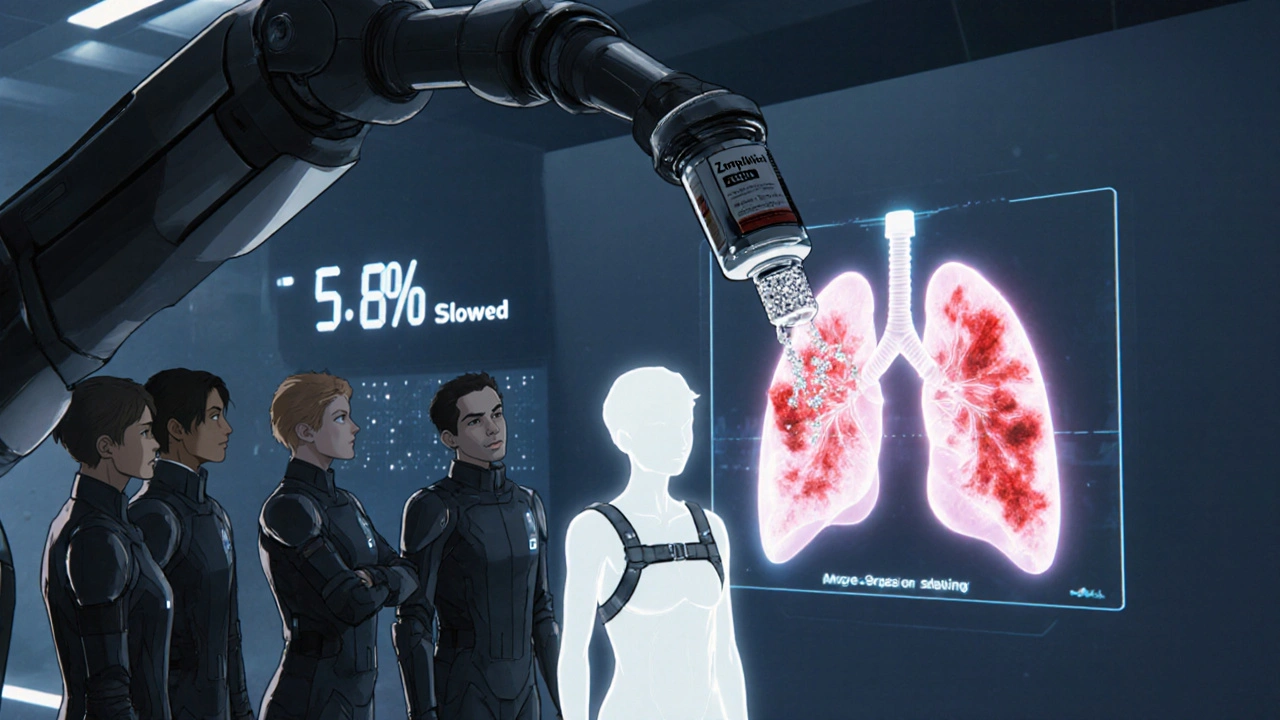
There’s no cure for the scarring. Once it’s there, it doesn’t go away. But you can slow it down. Two drugs-pirfenidone and nintedanib-are FDA-approved specifically for IPF. Both are antifibrotics, meaning they target the scarring process itself. In clinical trials, they cut the rate of lung function decline by about half over a year. That’s not a miracle, but it’s meaningful. It means you might walk longer, breathe easier, and stay out of the hospital.
Pirfenidone (Esbriet®) is taken as three pills three times a day. Side effects? Up to 65% of people get nausea, loss of appetite, or sun sensitivity. You need to avoid direct sunlight and use strong sunscreen. Nintedanib (Ofev®) is taken twice daily. It’s harder on the stomach-58% of users report diarrhea or cramps. Both cost over $9,000 a month, but most insurance plans cover them for confirmed IPF.
Here’s the catch: these drugs only work well for IPF. For other types of ILD-like those caused by arthritis or sarcoidosis-they show little benefit. That’s why getting the exact subtype right matters so much. A multidisciplinary team-pulmonologist, radiologist, pathologist-needs to review your scans and biopsies together. At top centers, this reduces misdiagnosis to under 10%.
What Else Helps Beyond Pills?
Medications aren’t the whole story. Pulmonary rehabilitation is one of the most effective tools you can use. It’s not just exercise. It’s a 8-12 week program with supervised breathing training, strength work, and education. People who finish it gain 45-60 meters on their 6-minute walk test-the standard measure of how far you can walk before needing to stop. That’s not just a number. It means you can get to the bathroom without resting. It means you can go out with friends again.
Oxygen therapy becomes necessary when your blood oxygen drops below 88% at rest. About half of IPF patients need it within two years. Modern portable oxygen concentrators are lightweight and quiet. But learning to use them properly takes training-usually 3-4 sessions with a respiratory therapist. Many patients don’t realize how much oxygen they need until they try walking or climbing stairs with it on.
Energy conservation techniques are just as important. Simple changes-sitting while brushing your teeth, using a cart for groceries, pacing your day-can make a huge difference. Occupational therapists teach these skills. Most patients need 4-6 weeks to get comfortable with them.
What’s New in ILD Treatment?
The field is moving fast. In September 2023, the FDA approved zampilodib, the first new antifibrotic drug in nearly a decade. It showed a 48% reduction in lung function decline compared to placebo in a major trial. That’s a big step forward.
Doctors are also starting to use blood tests to predict who’s at highest risk. A genetic marker called MUC5B promoter polymorphism is now tested in suspected IPF cases. If it’s positive, your chance of rapid progression jumps to 85%. That helps doctors decide who needs aggressive treatment right away.
Artificial intelligence is stepping in, too. Mayo Clinic’s AI tool can analyze HRCT scans and spot ILD patterns with 92% accuracy-better than even experienced radiologists. This means faster, more precise diagnoses, especially in smaller hospitals that don’t have ILD specialists.
Future treatments are being tested right now: stem cell therapies, new kinase inhibitors, and even drugs that target specific genes linked to scarring. Over 14 genes have been tied to ILD risk, and personalized medicine based on your DNA is no longer science fiction.

Living With ILD: The Real Challenges
It’s not just about medicine. The emotional toll is heavy. Two out of three patients report serious anxiety about breathing. Nearly half stop seeing friends because they need oxygen or fear having an attack in public. Caregivers-often spouses or adult children-spend over 20 hours a week helping with oxygen tanks, medication schedules, and mobility.
And the financial burden? The drugs alone can cost $100,000 a year. Even with insurance, co-pays and uncovered costs pile up. Many patients delay treatment because they can’t afford it. That’s why patient advocacy groups like the Pulmonary Fibrosis Foundation offer financial aid and navigation services.
But there’s hope. People who join support groups, stick with rehab, and stay in close contact with their ILD team live longer and feel better. One woman in Bristol, diagnosed with IPF in 2022, started rehab and switched to home oxygen. She now walks her dog every morning, cooks dinner, and plays with her grandchildren. She didn’t get better. But she got to keep living.
When Should You Seek Help?
If you’re over 50 and have a persistent dry cough, unexplained shortness of breath, or fatigue that doesn’t improve, don’t brush it off. If you’ve worked in construction, farming, or mining-or if you have an autoimmune disease like rheumatoid arthritis or lupus-you’re at higher risk. Ask your doctor for a chest CT scan and lung function test. Don’t wait for it to get worse.
ILD is not a death sentence. It’s a chronic condition that demands attention, but with the right care, many people live full, active lives for years. The key is acting early, knowing your subtype, and staying engaged with your care team.
Can interstitial lung disease be reversed?
No, the scar tissue in the lungs caused by ILD is permanent and cannot be reversed. However, treatments like antifibrotic drugs (pirfenidone and nintedanib) can slow down further scarring, helping preserve lung function and improve quality of life. In cases triggered by environmental exposure or certain medications, removing the trigger may stop progression and sometimes allow partial recovery.
How is ILD different from COPD or asthma?
ILD causes stiff, scarred lung tissue that restricts expansion, leading to a restrictive pattern on lung tests. COPD and asthma cause airway narrowing and airflow obstruction, seen as an obstructive pattern. ILD patients typically have a dry cough and low oxygen levels, while COPD patients often have mucus production and wheezing. Asthma symptoms come and go; ILD symptoms get worse over time.
What’s the life expectancy with ILD?
It depends heavily on the subtype. For idiopathic pulmonary fibrosis (IPF), median survival without treatment is 3-5 years. With antifibrotic drugs, many live 5-7 years or longer. Other forms, like sarcoidosis or connective tissue disease-related ILD, can have much better outcomes-with 5-year survival rates of 70-80%. Early diagnosis and treatment make a major difference.
Can I still travel with ILD and oxygen?
Yes, many people with ILD travel safely with portable oxygen concentrators. Airlines allow FAA-approved devices, but you must notify them at least 48 hours in advance and bring extra batteries. Always carry a prescription for oxygen and a letter from your doctor. Plan rest stops, avoid high altitudes, and monitor your oxygen levels during flights.
Are there any new drugs on the horizon for ILD?
Yes. Zampilodib, approved in late 2023, is the first new antifibrotic since 2014 and shows stronger results in slowing lung decline. Over 25 clinical trials are testing new drugs targeting inflammation, fibrosis, and genetic pathways. Stem cell therapies and combination treatments are also in early-phase testing. The goal is to develop subtype-specific therapies, not just one-size-fits-all drugs.
How do I know if my ILD is getting worse?
Watch for increased breathlessness during daily tasks, more frequent coughing, needing more oxygen, losing weight without trying, or feeling more tired than usual. A drop of more than 50 meters in your 6-minute walk distance over a year is a strong sign of progression. Regular follow-ups with your pulmonologist-including lung function tests and CT scans-are essential to catch changes early.
What’s Next?
If you or someone you care about has been diagnosed with ILD, don’t wait. Find a center with a dedicated ILD clinic-these are usually at academic hospitals. Ask for a multidisciplinary review. Start pulmonary rehab. Learn about oxygen use. Join a support group. You’re not alone. Thousands of people are managing this disease with dignity and strength. The science is advancing. The tools are better. And with the right care, you can still live well-even with scarred lungs.




Jacob Keil
November 30, 2025 AT 22:06so like... if your lungs are wrapped in plastic wrap, does that mean we're all just slow-motion zombies waiting for our oxygen to get cut off? i mean, science says scar tissue is permanent but what if the real problem is our bodies are just too lazy to heal? like, why do we even have immune systems if they just turn into overzealous glue factories? also i typed this on my phone so sorry for the typos but you get the point.
Rosy Wilkens
December 1, 2025 AT 22:51Let me be perfectly clear: this entire article is a corporate-sponsored illusion. The FDA approved pirfenidone and nintedanib not because they work-but because Big Pharma bought off the review boards. The real cause of ILD? 5G towers, fluoridated water, and microplastics in your tap. You think your lungs are scarred? They’re poisoned. And the ‘multidisciplinary teams’? They’re just trained to look the other way while you bleed money into pills that don’t cure anything. I’ve read every clinical trial. None of them are blind. None of them are honest.
Andrea Jones
December 2, 2025 AT 02:32Okay but let’s be real-pulmonary rehab is the real MVP here. I know someone who started it after being told she had 18 months left. Now she’s hiking weekend trails with her oxygen tank in a backpack like it’s a fanny pack. The meds? They slow the clock. Rehab? It lets you live while the clock ticks. Also, if you’re not doing breath training, you’re basically letting your lungs go on strike. And no, ‘just breathe deeper’ doesn’t count. You need structure. You need a coach. You need to stop pretending you’re fine until you collapse.
Justina Maynard
December 3, 2025 AT 01:01The linguistic precision of this post is astonishing-particularly the metaphor of lungs wrapped in plastic wrap, which evokes both suffocation and industrial decay. The structural progression from pathophysiology to socioeconomic burden mirrors the clinical trajectory of ILD itself: insidious, cumulative, and devastatingly underfunded. I’m particularly struck by the MUC5B polymorphism data; it suggests fibrosis isn’t merely a disease of aging but of genetic vulnerability masked by environmental triggers. The fact that AI outperforms radiologists in pattern recognition should terrify us-not because machines are better, but because human expertise is being outsourced to algorithms we don’t understand. We are entering an era where diagnosis is algorithmic, but care remains profoundly human. And that dissonance? That’s the real pathology.
Evelyn Salazar Garcia
December 3, 2025 AT 17:03USA spends billions on this but China cures it with herbs and acupuncture. Why are we paying $10k a month for pills that don’t fix anything? Just say no to Big Pharma.
Clay Johnson
December 5, 2025 AT 01:32Scar tissue doesn’t reverse. That’s biology. But the idea that slowing decline equals hope is a comforting lie. We don’t treat ILD-we manage decline. And we call that progress. The real innovation isn’t in the drugs. It’s in the language we use to make suffering sound like a clinical achievement.
Jermaine Jordan
December 5, 2025 AT 06:01THIS IS WHY WE NEED TO TALK ABOUT ILD. Not in medical journals. Not in insurance forms. But in kitchens. In living rooms. In grocery lines. One woman in Bristol? She’s not a statistic. She’s a revolution. Every time she walks her dog, she’s telling the disease: ‘Not today.’ Every time she cooks dinner, she’s rewriting the script. This isn’t about drugs or scans-it’s about refusing to disappear. If you’re reading this and you’re scared? Good. Fear means you’re still alive. Now go find a rehab program. Go join a group. Go fight. Your lungs are scarred. But your spirit? That’s still yours to keep.
Chetan Chauhan
December 6, 2025 AT 21:10u all missing the point. in india we dont use these expensive pills. we use turmeric, neem, and breathing in forest air. no one here gets ILD. its a first world problem caused by pollution and too much sitting in air conditioning. also why is everyone so obsessed with oxygen tanks? just go outside. breathe. simple.
Phil Thornton
December 7, 2025 AT 11:26They made a drug that costs more than my car. And I’m supposed to be grateful?
Pranab Daulagupu
December 8, 2025 AT 07:54For those of us living with ILD, the real breakthrough isn't the drug-it's the community. The people who show up with groceries when you can't walk. The ones who learn how to refill your oxygen tank. The ones who don't say 'you're brave' but just sit with you in silence. Science gives us tools. But humanity gives us reason to use them.