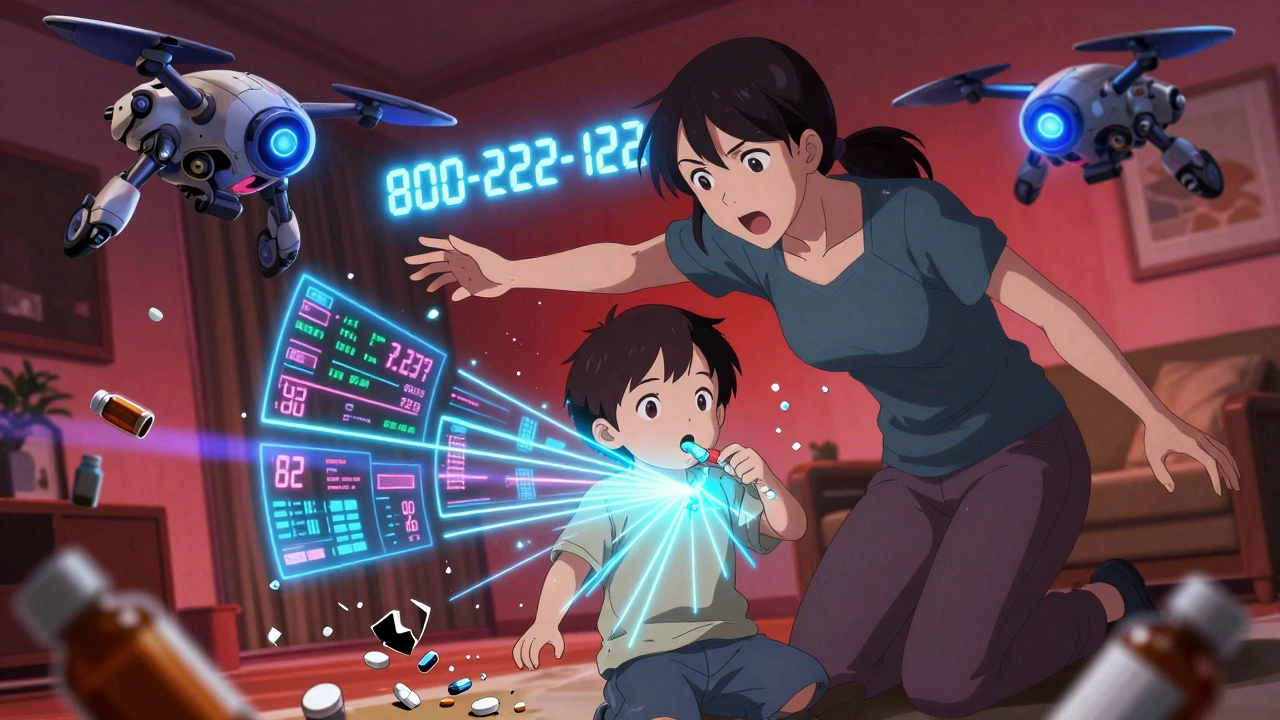
If your child swallows the wrong medication, time is the most critical factor. Every second counts. Panic won’t help - but knowing exactly what to do next can save their life. This isn’t theoretical. In the U.S. alone, children under 5 are rushed to emergency rooms for medication poisoning over 60,000 times a year. Most of these cases happen at home, often because a pill was left on a nightstand, a liquid bottle wasn’t capped properly, or a child got into a grandparent’s medicine bag. The good news? You don’t need to be a doctor to act effectively. You just need to know the right steps - and act fast.
Step 1: Call Poison Control Immediately
Do not wait. Do not Google symptoms. Do not try to figure it out yourself. Pick up the phone and call Poison Control right now - even if your child seems fine. In the U.S., dial 800-222-1222. That number connects you to trained specialists who know exactly what to do based on the medication, the dose, and your child’s weight and age. They’ve seen this before. Thousands of times. They’ll ask you for details: what was swallowed, how much, when, and your child’s current condition. Have the medication bottle ready if you can. But don’t waste time searching for it - call first. The poison center can guide you through the next steps while you’re still holding the phone. Studies show that calling Poison Control reduces hospitalization rates by 43%. That’s not a small number. That’s life-changing.Step 2: Remove Any Remaining Medication from the Mouth
While you’re on the phone with Poison Control, gently check your child’s mouth. Use your fingers to remove any pills, liquid, or patches you can see. Don’t force it. Don’t stick your finger down their throat. Just take out what’s loose. If it’s a medicated patch - like fentanyl or nicotine - peel it off carefully. These patches can stick to the roof of the mouth or inside the cheek and keep releasing drugs for hours. You need to remove them now.Step 3: Do NOT Induce Vomiting
This is the most dangerous myth still floating around. Many older parents remember being told to make a child throw up after swallowing something bad. That advice is outdated, dangerous, and has been rejected by every major medical organization since 2004. Syrup of ipecac is no longer recommended. It doesn’t work well. And it can make things worse. Vomiting can cause the child to aspirate - meaning the substance gets sucked into the lungs. That can lead to pneumonia, breathing failure, or even death. Some medications, like bleach or cleaning products, can burn the throat again on the way back up. Even with pills, forcing vomiting can damage the esophagus or cause the pill to break open in the wrong place. Poison Control will tell you if vomiting is ever appropriate - and in nearly every case, the answer is no.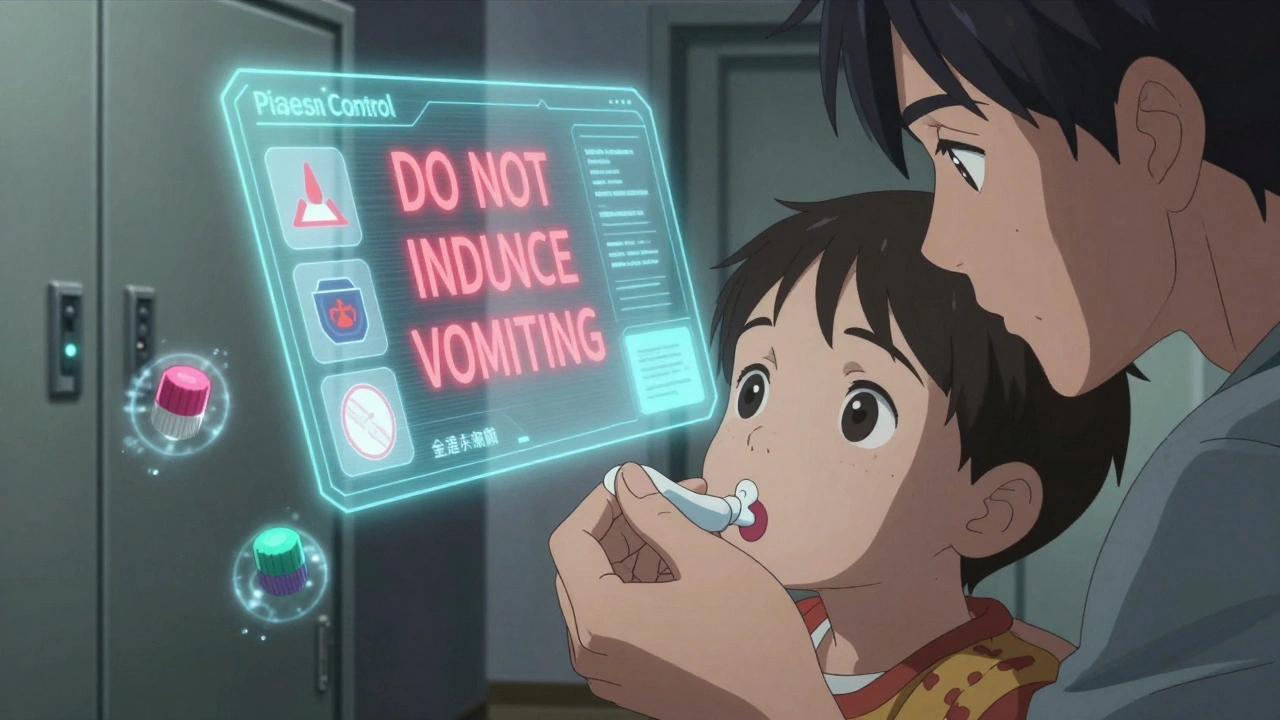
Step 4: Watch for These Emergency Signs - Call 911 Right Away
Not every ingestion needs a hospital trip. But some do. Call 911 or your local emergency number immediately if your child shows any of these symptoms:- Difficulty breathing or stopped breathing
- Loss of consciousness - even if they wake up quickly
- Seizures or unusual shaking
- Pupils that are extremely large or tiny
- Extreme drowsiness that lasts more than 20 minutes
- Excessive drooling or trouble swallowing
- Pale, cold, or bluish skin
Step 5: Know What Happens at the Hospital
Even if your child seems okay after calling Poison Control, they might still need to be monitored. Hospitals follow strict protocols for medication ingestions. For unknown substances, they’ll observe the child for at least 12 hours. Vital signs - heart rate, blood pressure, oxygen levels - are checked every 15 minutes in the first hour, then every 30 minutes after that. If they know what was swallowed, treatment becomes targeted:- Opioids (like oxycodone or fentanyl): Naloxone is given to reverse the effect. It works fast - often in minutes.
- Sulfonylureas (diabetes pills like glipizide): These can cause dangerous low blood sugar. Blood glucose is checked every 30 minutes. IV glucose is given if needed.
- Tricyclic antidepressants: Sodium bicarbonate is used to protect the heart rhythm.
- Most other pills: Activated charcoal may be given within the first hour to absorb the drug before it enters the bloodstream. But it’s not used for caustics, alcohol, or petroleum products.

What You Should Never Do
Here’s what not to do - because people still try these things:- Don’t give milk, water, or food unless told to. Some medications react badly with liquids. Others need to be absorbed slowly. Only follow Poison Control’s advice.
- Don’t wait to see if they “get better.” Some poisons take hours to show symptoms. Acetaminophen can look harmless for 12 hours - then suddenly damage the liver.
- Don’t assume it’s “just a little.” A single adult-strength pill can be lethal to a toddler. A child’s body is tiny. Their liver and kidneys can’t handle adult doses.
- Don’t rely on apps or online symptom checkers. They’re not trained for poison emergencies. Poison Control is.
How to Prevent This From Happening Again
The best emergency response is no emergency at all. Here’s what actually works:- Lock up all medications. Use childproof locks on cabinets - not just child-resistant caps. A determined 2-year-old can open those. CDC data shows homes with locked storage have 85% fewer accidental ingestions.
- Never leave pills on nightstands, counters, or in purses. That’s how it happens. A pill falls out of a pill organizer. A grandparent leaves their blood pressure meds on the coffee table. A child sees it, thinks it’s candy.
- Use medicine with flow restrictors. Since 2022, the American Academy of Pediatrics has required all liquid medications to have these. They cut the amount a child can swallow in one go by 58%.
- Consider smart pill dispensers. Devices like Hero Health alert you if a pill is taken at the wrong time - and lock the bottle if a child tries to open it. They’re not cheap ($90/month), but they’ve reduced accidental access by 73% in studies.
- Teach your kids: “Medicine is not candy.” Say it often. Show them the difference between candy and pills. Even toddlers can learn this.
Final Thought: You Are Not Alone
This happens more than you think. Parents feel guilty. They blame themselves. But the truth? Most of these incidents happen because we live in a world full of pills - and we’re not trained to handle them safely. The system isn’t perfect. But you are now. You know what to do. You know who to call. You know what not to do. Keep the Poison Control number saved in your phone. Tell your partner, your babysitter, your parents. Post it on the fridge. Make sure everyone who watches your child knows it. Because when it matters - you won’t have time to look it up.What should I do if my child swallowed a pill but seems fine?
Call Poison Control immediately - even if they seem fine. Many dangerous medications don’t cause symptoms right away. Acetaminophen can cause liver damage 12 to 24 hours after ingestion. A child who looks normal now could be in danger later. Poison Control will tell you whether to monitor at home or go to the hospital.
Can I use syrup of ipecac to make my child vomit?
No. Syrup of ipecac has not been recommended since 2004. It doesn’t reliably remove toxins and can cause serious side effects like aspiration pneumonia, seizures, or further injury to the throat. Poison Control and all major medical groups agree: never use it.
What if I don’t know what pill they swallowed?
Call Poison Control anyway. They can still help. Bring any empty containers, wrappers, or leftover pills with you to the hospital. If you’re unsure, describe the color, shape, markings, or size. Even partial information helps them identify the substance and guide treatment.
Is activated charcoal safe for children?
Yes - if given within one hour of ingestion and approved by Poison Control. It’s used for many types of pills and is generally safe for children when given at the right dose (1 gram per kilogram of body weight). But it’s not used for all substances - like acids, alkalis, alcohol, or petroleum products - because it doesn’t work and can make things worse.
How can I make sure my home is safe from medication accidents?
Store all medications - including vitamins and supplements - in locked cabinets, out of reach and sight. Use child-resistant caps, but don’t rely on them alone. Keep purses and bags with pills off the floor. Never leave pills on counters or nightstands. Use flow-restricted bottles for liquids. Consider a smart pill dispenser if you have multiple medications in the house. These steps cut accidental ingestions by up to 85%.
What’s the most common cause of fatal medication poisoning in young children?
Pain medications - especially those containing acetaminophen - are responsible for 31% of poisoning-related deaths in children under 5. A single adult tablet can be lethal. Other high-risk medications include heart pills (like beta-blockers), antidepressants, and diabetes drugs. Always treat any medication as potentially deadly in a child’s hands.



Vivian Amadi
December 10, 2025 AT 23:22STOP. Just stop. You think you're helping but you're not. I've seen this happen three times in my ER. One kid swallowed a fentanyl patch. Mom tried to make him throw up. He aspirated. Died. Poison Control is the ONLY thing that matters. Save the drama for TikTok.
Jimmy Kärnfeldt
December 10, 2025 AT 23:47Man, this post hit different. I used to think 'it's just a pill' until my niece swallowed my blood pressure meds. She was fine for hours. Then she started nodding off. We called Poison Control. They told us to watch her pupils. We didn't even know what that meant. Now I keep their number on my fridge. And I lock everything. Seriously. Just lock it.
Ariel Nichole
December 11, 2025 AT 20:51Thanks for laying this out so clearly. I shared this with my sister who's a new grandma. She leaves her pills on the coffee table like it's no big deal. This might save a life. Really.
Monica Evan
December 13, 2025 AT 01:07ok so i just wanna say i used to think syrup of ipecac was a thing like in the 90s movies but nope its not just dont do it. i work in a pharmacy and we used to get calls all the time like 'my kid ate a baby aspirin should i make him puke' and we had to say NO NO NO. also i keep the poison control number saved as 'LIFE LINE' in my phone. its not a joke. its the number you call when your heart stops.
Jim Irish
December 13, 2025 AT 05:31It is imperative that caregivers understand the urgency of contacting Poison Control prior to attempting any intervention. The data supporting this protocol is unequivocal. Vomiting induces aspiration risk and delays definitive care. This guidance is not merely advisory-it is standard of care.
Mia Kingsley
December 14, 2025 AT 19:08Wait so you're telling me I'm a bad mom because I didn't know about flow restrictors? Like I'm supposed to be a pharmaceutical engineer now? Also why are we ignoring that 70% of these cases happen when grandparents visit? My mom leaves her meds out like it's a snack bowl. I'm not the problem here.
Katherine Liu-Bevan
December 16, 2025 AT 12:16Activated charcoal is effective for many ingestions, but only when administered within the first hour and under medical guidance. It is contraindicated for caustic substances, hydrocarbons, and alcohols. The dosage is 1 gram per kilogram of body weight. Hospitals will not use it routinely-it is a targeted intervention. Always defer to Poison Control before any action.
Lisa Stringfellow
December 16, 2025 AT 20:23Why do we always blame the parents? The pharmaceutical companies make pills look like candy. The packaging is designed to be appealing. The FDA approves this. The system is broken. And now you're telling me I'm a bad parent because my kid found a pill on the counter? You're not fixing the problem. You're just shaming mothers.
Aman deep
December 18, 2025 AT 06:06in india we dont have poison control numbers on every phone but we do have a habit of giving neem water or turmeric paste. not sure if it helps but we do it. i think the real issue is people dont know what's in their own medicine cabinet. my cousin gave his kid a painkiller for fever and it was actually a heart pill. he thought they were the same because both were white. we need to teach this in schools. not just in the us.
Eddie Bennett
December 20, 2025 AT 03:07Just saw a mom on the news who did everything right. Called Poison Control, removed the patch, didn't induce vomiting. Kid’s fine. But she cried for 20 minutes after. That’s the real cost. We don’t talk about the trauma. We just talk about steps. This isn’t just medical-it’s emotional.
Sylvia Frenzel
December 21, 2025 AT 06:25Why are we letting foreigners dictate our parenting? We used to raise kids without all this panic. My grandma gave me aspirin when I was three. I’m fine. Why is everything a crisis now? This post is fear-mongering disguised as help.
Michaux Hyatt
December 22, 2025 AT 14:34Thank you for sharing this. I’m the author of the post. I didn’t expect this kind of response. But I want to say something to everyone here: you’re not alone. I’ve been in that panic. I’ve held my child while waiting for Poison Control to answer. And I promise you-knowing what to do next doesn’t make you a perfect parent. It just makes you prepared. Keep sharing this. Keep saving lives.