
When you pick up a prescription at the pharmacy, you might not realize that the decision between a brand-name drug and its generic version isn’t just up to your doctor or your insurance. In many states, there are hidden rules, financial nudges, and even legal requirements designed to steer you-and your doctor-toward cheaper, equally effective generic medications. These aren’t random policies. They’re deliberate, state-level strategies to save billions in public healthcare spending, and they’re working in ways most people never notice.
Let’s be clear: generic drugs aren’t second-rate. They contain the same active ingredients, work the same way, and are held to the same safety standards as brand-name drugs. The only real difference? Price. A generic version of a drug can cost 80% less than the brand. That’s why states have spent decades building systems to push pharmacies, doctors, and patients toward generics. And the most effective tools aren’t laws forcing substitution-they’re incentives that make the smart choice the easy one.
How States Push for Generic Use
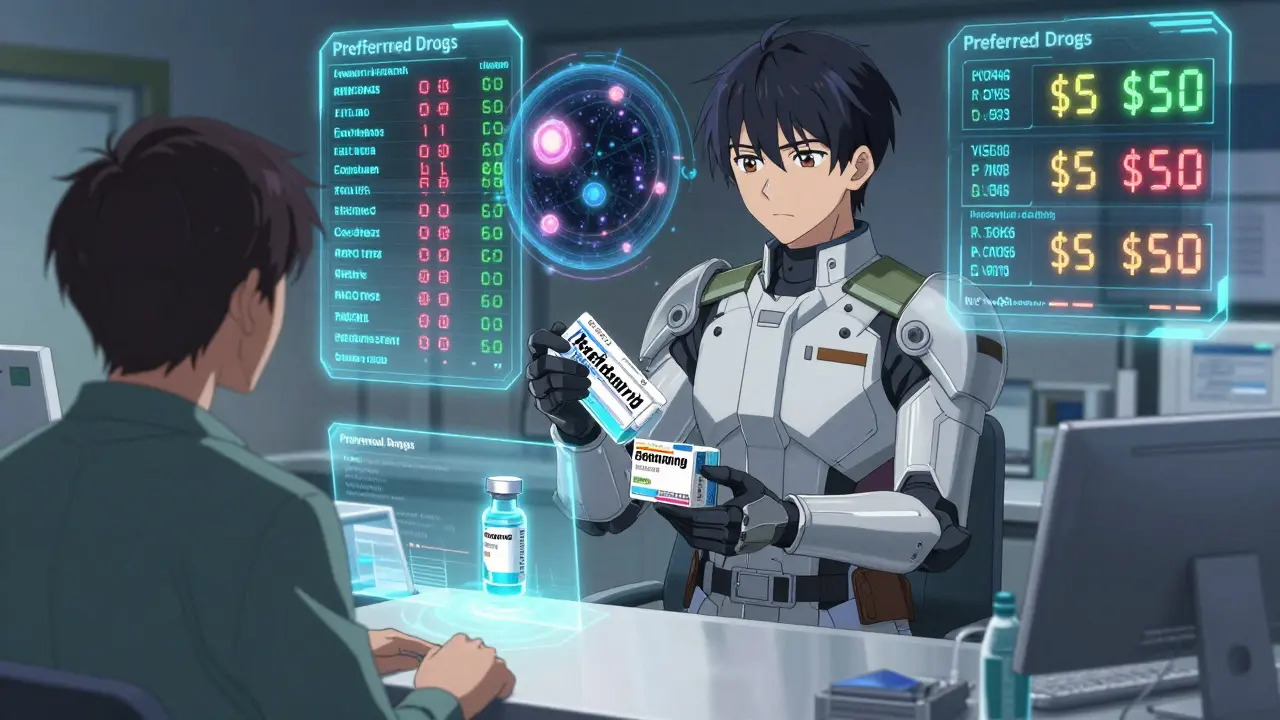
States don’t just hope people choose generics. They build systems that make it harder not to. The most common method? Preferred Drug Lists (PDLs). These are lists of medications that Medicaid programs approve as the first-line option for treatment. If your doctor prescribes a drug not on the list, you might have to jump through hoops-like getting prior authorization-or pay a much higher copay. As of 2019, 46 out of 50 states had PDLs in place for their Medicaid programs. That’s not a coincidence. It’s a strategy.
These lists aren’t static. Twenty states review them every year. Ten do it quarterly. That’s because drug prices shift fast. A generic might be cheap today, but if a manufacturer raises its price, it can get bumped off the list. Meanwhile, a new generic might slip in. It’s a living system, constantly adapting to what’s cheapest and most effective.
Another tool? Pharmacist substitution rules. In some states, pharmacists can automatically swap a brand-name drug for a generic without asking you. That’s called “presumed consent.” In others, they have to ask you first-“explicit consent.” The difference matters. A 2018 NIH study found that presumed consent laws increased generic dispensing by 3.2 percentage points. That might sound small, but multiply that across millions of prescriptions, and you’re talking about billions saved. If all 39 states with explicit consent rules switched to presumed consent, researchers estimated they’d cut annual drug spending by over $50 billion.
The Real Power Move: Copay Differentials
Here’s where things get personal. States don’t just rely on doctors or pharmacists. They put the pressure on you-the patient. How? By making the generic option dramatically cheaper at the counter.
Picture this: your brand-name drug costs $50 out-of-pocket. The generic? $5. That’s not a suggestion. That’s a financial nudge so strong, most people don’t even think twice. In 2000, the Kaiser Family Foundation found that the difference in pharmacy dispensing fees between brand and generic drugs had shrunk to just 8 cents. But copay differentials? They kept growing. States realized: if you want people to choose generics, make it hurt less to do so.
And it works. When patients face higher copays for brand-name drugs, they switch. Studies show that a $3 increase in the price of a brand-name drug has the same effect as a presumed consent law. In other words, putting the cost difference directly in the patient’s hands is more powerful than any rule forcing pharmacists to substitute.
That’s why states have moved away from trying to control pharmacists and toward controlling what patients pay. The goal isn’t to eliminate brand-name drugs-it’s to make generics the default. And it’s working.
What About the 340B Program and Medicaid Rebates?
It’s not just about copays. States also use federal programs to stretch their budgets further. The 340B Drug Pricing Program, created in 1992, lets safety-net hospitals and clinics buy drugs at steep discounts-often 20% to 50% off list price. These savings help clinics serve low-income patients without going broke. But here’s the twist: when states reimburse pharmacies for 340B drugs, they’re required to pay no more than the discounted price. That means if a pharmacy tries to charge more, the state won’t cover it. That alone pushes pharmacies to stock generics, since they’re cheaper to begin with and fit better under the 340B cap.
Then there’s the Medicaid Drug Rebate Program. Since 1990, drug manufacturers have been required to pay rebates to states for every prescription filled. For generics, the base rebate is 13% of the average price. But states don’t stop there. Forty-six states negotiate extra rebates on top of that-especially for drugs on their Preferred Drug Lists. That means the more generics a state uses, the more money it gets back from manufacturers. It’s a feedback loop: lower cost → higher usage → bigger rebates → more savings.
But it’s not all smooth sailing. Generic manufacturers can get hit with unexpected rebates. If a drug’s price doesn’t go up, but the market changes-say, due to a shortage or a drop in sales-the rebate formula can still trigger a payment. That’s led some manufacturers to pull generic drugs out of the Medicaid market entirely. It’s ironic: the very system designed to increase access can sometimes reduce it.
Why Some Policies Fail
Not every state policy works as intended. Take mandatory substitution laws-rules that say pharmacists must swap generics. You’d think they’d boost usage. But research shows they don’t. Why? Because pharmacists already have a financial reason to substitute: they make more profit on generics. The law doesn’t change their behavior-it just adds paperwork. The real driver isn’t regulation. It’s economics.
Same goes for trying to control doctors. Some states tried to limit prescribing of brand-name drugs by requiring prior authorization. But doctors often just write the prescription anyway and let the patient deal with the higher copay. The burden shifts, but the behavior doesn’t change. The most effective policies? Those that change what the patient pays at the counter.
And then there’s the problem of new drugs. Even as generic use rose from 33% of prescriptions in 1993 to 45% by 1998, total spending on drugs kept climbing. Why? Because brand-name drugs were getting more expensive. A single new drug can cost $100,000 a year. No amount of generic substitution can offset that. So while states have gotten better at managing existing drugs, they’re still struggling with the flood of ultra-expensive new therapies.

The Future: A Drug List?
CMS, the federal agency that runs Medicare, is now testing a bold idea: a $2 Drug List for Medicare Part D. The goal? Make the cheapest generics cost just $2 per prescription-no matter what your insurance plan is. It’s simple, predictable, and removes all the confusion around copays. If it works, states will likely copy it. Why? Because it’s the ultimate incentive: make the generic so cheap that choosing anything else feels irrational.
States are watching closely. If a federal program can standardize low-cost access, it could become the new gold standard. And with drug prices still climbing, states have no choice but to keep innovating. The tools may change-more copay caps, more automated substitution, more rebate negotiations-but the goal stays the same: get the best care at the lowest cost.
What This Means for You
If you’re on Medicaid, a Medicare Part D plan, or even a private insurance plan, these policies affect you. You might not see them, but they’re there-shaping what you pay, what your pharmacist offers, and even what your doctor prescribes. The next time you pick up a prescription, ask: is this the generic? If not, why? You might be surprised how often the answer is: because it’s cheaper, and you’re already saving money.
Are generic drugs really as effective as brand-name drugs?
Yes. Generic drugs must meet the same FDA standards as brand-name drugs for active ingredients, dosage, strength, safety, and effectiveness. The only differences are in inactive ingredients (like fillers or dyes) and packaging. Studies consistently show generics perform the same in clinical use. The FDA requires bioequivalence testing to prove they work just as well.
Why do some pharmacies still give brand-name drugs even when a generic is available?
Sometimes it’s because the patient or doctor requested it. Other times, the generic isn’t in stock, or the prescription was written for the brand name with no substitution allowed. In rare cases, a patient might have an allergy to an inactive ingredient in the generic. But if the prescription allows substitution and the generic is available, the pharmacist should offer it-especially if the copay is much lower.
Do all states have the same rules for generic substitution?
No. States vary widely. Some allow pharmacists to substitute without asking (presumed consent), while others require your permission (explicit consent). Some have strict Preferred Drug Lists, while others rely mostly on copay differentials. Only 15 states and Puerto Rico have laws specifically regulating copay adjustments for generics as of 2022. The rules depend on state legislature, Medicaid policies, and local pharmacy practices.
Can generic drugs be pulled from the market because of state rebate policies?
Yes. When generic manufacturers face Medicaid inflation rebates without raising prices-due to market shifts like shortages or declining sales-they can lose money on each sale. In some cases, they stop supplying the drug to Medicaid altogether. This happened with several common generics in recent years, leaving patients with fewer options. It’s an unintended consequence of well-intentioned cost-control policies.
What’s the difference between a Preferred Drug List and a formulary?
A Preferred Drug List (PDL) is a state Medicaid tool that identifies drugs with the best value-usually generics-and requires prior authorization or higher copays for non-preferred options. A formulary is broader-it’s a list of drugs covered by a private insurance plan or Medicare Part D. Formularies can include brand-name drugs, and they’re often managed by Pharmacy Benefit Managers (PBMs). PDLs are public policy tools; formularies are private contracts.





christian jon
February 13, 2026 AT 02:29Oh MY GOD. Did you know that in some states, pharmacists can just SWAP your brand-name drug for generic WITHOUT ASKING?! I mean, who gave them that power?! It’s like they’re playing God with your prescription-no consent, no dialogue, just a cold, clinical swap. And we call this ‘savings’?! What about patient autonomy?! This isn’t healthcare-it’s pharmaceutical authoritarianism. I’m not some lab rat to be herded into cheaper meds. Where’s my freaking choice?!
And don’t even get me started on Medicaid rebates. The system’s rigged. Manufacturers get squeezed so hard they stop making generics altogether-so now we have SHORTAGES. Brilliant. Just brilliant. You want to save money? Then stop punishing the companies that make the drugs. Fix the middlemen. Fix the PBMs. Stop using patients as bargaining chips.
steve sunio
February 13, 2026 AT 05:56generic drugs r just as good as brand name lol. why are u so stressed? ur just mad cause u get free stuff now. u dont even know how much u save. chill. its not rocket science.
Neha Motiwala
February 14, 2026 AT 09:00They’re not just pushing generics-they’re engineering dependency. Think about it. The 340B program? Medicaid rebates? All these ‘cost-saving’ measures? They’re not about health-they’re about control. Who benefits? Big Pharma, sure, but also the state agencies that get kickbacks from rebate negotiations. And who gets caught in the middle? You. Me. The elderly on fixed incomes. They don’t care if you can’t get the drug you need-they care about the numbers. And if a generic disappears because the math doesn’t add up? Well, too bad. You’re supposed to be grateful for the ‘savings.’
They’re turning healthcare into a spreadsheet. And we’re the cells being erased.
athmaja biju
February 15, 2026 AT 18:10India has been doing this for decades. We don’t have brand-name obsession. We have generic drugs that are 95% effective and cost 1/10th the price. Why? Because we don’t worship patents. We value access. America’s problem isn’t drug pricing-it’s cultural arrogance. You think paying $500 for a pill makes you superior. It doesn’t. It makes you a sucker.
States are finally catching up. Good. Let’s see how long it takes for Big Pharma to lobby this away. Spoiler: It won’t last. But at least now we know it’s possible.
Robert Petersen
February 16, 2026 AT 14:48This is actually one of the most underrated public health wins I’ve seen in years. I used to think generics were ‘lesser,’ but after my mom switched from a $120 brand to a $4 generic for her blood pressure meds and her numbers stayed perfect? I was blown away.
It’s not about forcing anyone-it’s about making the smart choice the easy one. And honestly? The copay differentials are genius. When the difference is $5 vs $50, even the most skeptical person says ‘yeah, I’ll take the cheaper one.’ No coercion needed. Just common sense.
Keep pushing this. More states need to adopt this. It’s working. Real people are saving real money. And that’s what matters.
Ernie Simsek
February 17, 2026 AT 06:21bro the $2 drug list is the future 😍 imagine walking in and everything’s two bucks. no copay drama. no prior auth. no confusing tiers. just pick your meds and go. it’s like a vending machine for health. why isn’t this everywhere already??
also pharma companies are crying because they lost the ‘brand = better’ lie. time to wake up, guys. your 2003 marketing playbook doesn’t work anymore.
Joanne Tan
February 18, 2026 AT 00:02OMG I just realized my pharmacy has been switching my meds without telling me and I didn’t even notice! I thought I was getting the same thing. Turns out I’ve been on generic for 6 months and my blood sugar is better than ever. Who knew?!
Also-can we talk about how the 340B program helps clinics in rural areas? My cousin works at one and they literally couldn’t afford to keep running without it. This isn’t just about money-it’s about access. So many people would lose care if this got cut.
Reggie McIntyre
February 19, 2026 AT 18:30Here’s the real kicker: the most effective policy isn’t a law-it’s a price tag. People don’t respond to mandates. They respond to incentives. And when you make the generic $5 and the brand $50? You don’t need to convince anyone. You just need to show up.
It’s behavioral economics in action. The state didn’t need to lecture us. It just changed the game. And now, instead of fighting patients, pharmacists are *cheering* for generics. They make more profit on them. Doctors are happy because patients aren’t skipping doses due to cost. Everyone wins-except the companies that sold us the myth that brand = better.
It’s not magic. It’s math. And math, for once, is on the side of the people.
Gloria Ricky
February 20, 2026 AT 03:28Wait-so if a generic gets pulled because of rebate rules, that means people are losing access? That’s wild. I didn’t realize the system could backfire like that. I thought all this was just helping.
So… are we punishing the manufacturers so hard that they stop making the drugs we need? That’s… kinda messed up. Like, we’re trying to fix a problem but accidentally making another one? Can we tweak the rebate formula? Maybe cap it at a certain percentage? I feel like this needs a fix before it gets worse.
Kristin Jarecki
February 21, 2026 AT 12:02It is imperative to acknowledge that the efficacy of generic medications is not merely a matter of regulatory compliance but of clinical validation. The Food and Drug Administration mandates bioequivalence, and numerous peer-reviewed studies corroborate the therapeutic parity between branded and generic formulations. The perception of inferiority is a psychological artifact, not a pharmacological reality.
Furthermore, the structural incentives embedded within state Medicaid programs-namely, preferred drug lists and differential copay structures-constitute a paradigm shift in public health economics. These mechanisms align fiscal responsibility with clinical outcomes, thereby reducing avoidable morbidity attributable to non-adherence due to cost burdens.
It is neither paternalistic nor punitive; it is prudent policy.
Rachidi Toupé GAGNON
February 22, 2026 AT 00:47$2 generics? Yes please. 🙌 I’m tired of choosing between meds and groceries. This is the kind of policy that actually helps people. Not theory. Not lobbying. Real change.
Let’s do it. Everywhere. Now.
Jim Johnson
February 22, 2026 AT 06:39My grandma switched to generic insulin and saved $200 a month. She cried. Not from sadness-from relief. I didn’t even know that was possible until this article.
Also, I had no idea pharmacists could swap without asking. That’s kinda wild… but also kinda awesome? Like, if the science says it’s the same, why make us jump through hoops? Just give us the cheaper stuff.
Can we make this federal? Please? I don’t want anyone else to have to choose between meds and rent.
Vamsi Krishna
February 22, 2026 AT 18:53They’re not saving money-they’re rationing care under the guise of efficiency. You think it’s about savings? No. It’s about control. Who decides what’s ‘preferred’? A committee. Who’s on that committee? People who’ve never met a patient. Who gets left out? The ones with allergies, the ones with rare conditions, the ones who just… need the brand.
And don’t get me started on how they punish manufacturers. You think they’re helping? No. They’re creating shortages. They’re making people wait. They’re turning medicine into a game of Russian roulette.
It’s not innovation. It’s exploitation dressed up as compassion.
Craig Staszak
February 24, 2026 AT 09:33Love this. The $2 drug list could be a game changer. Imagine if we applied this to chronic meds-diabetes, hypertension, asthma. People wouldn’t skip doses. ER visits would drop. Lives saved.
Why isn’t this on every ballot? Why are we still arguing about this? Just make it happen.
alex clo
February 24, 2026 AT 17:32The empirical evidence supporting the therapeutic equivalence of generic medications is overwhelming and well-documented by the FDA and independent clinical trials. The persistent stigma surrounding generics is rooted in marketing narratives rather than pharmacological science. Policy interventions that reduce cost barriers through copay differentials and preferred drug lists represent evidence-based, cost-effective strategies that enhance medication adherence and public health outcomes. The moral imperative to prioritize accessibility over profit margins is both clear and urgent.